
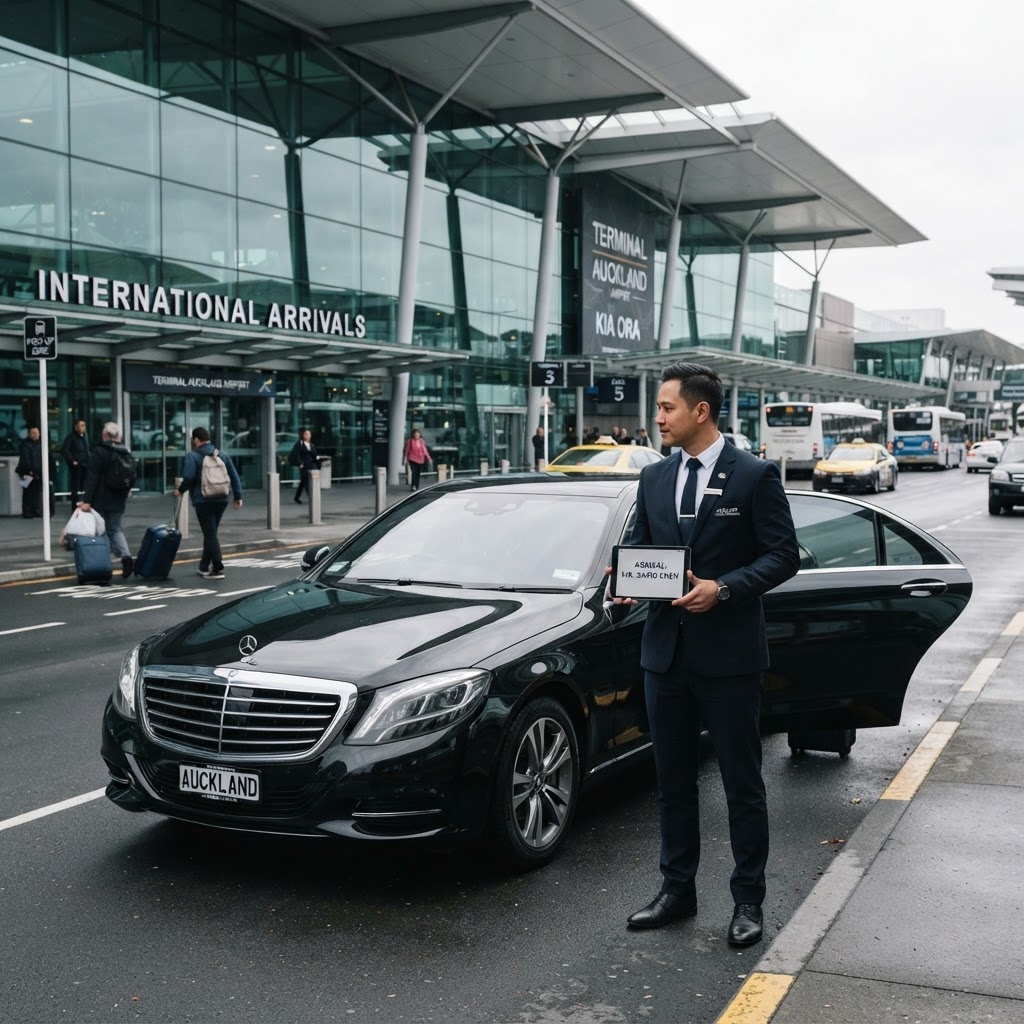
Chauffeur Airport Pickup Auckland: What Professional Service Actually Looks Like in 2025
Auckland Airport handles over 21 million passengers annually across international and domestic terminals separated by 2.4 kilometres of ring road. If you're searching for chauffeur airport pickup Auckland, you're likely facing one of three scenarios: inbound international client arrival, domestic executive connection, or group movement requiring coordinated fleet dispatch. The service you need depends entirely on which scenario applies — and whether your provider has the operational infrastructure to deliver it reliably.
This isn't about marketing promises. It's about fleet composition, driver accreditation, real-time flight tracking integration, and the operational capacity to manage 40+ airport movements daily without a single vehicle doing double duty or a driver running late because they're solo-operating across three bookings.
Meet & Greet vs kerbside pickup: understanding service tiers
Meet & Greet means your driver clears airside security, holds signage at the arrivals gate, assists with luggage from the carousel, and escorts passengers directly to the vehicle in the parking structure or priority pick-up zone. This requires:
- Current airport security clearance for every driver (not all operators maintain this)
- Real-time flight tracking with automatic delay adjustment
- Pre-positioned vehicle in P2 short-term or commercial holding area
- Direct mobile contact between driver and passenger if required
Kerbside pickup means the driver waits at the terminal kerb — international or domestic — and meets the passenger outside baggage claim. It's faster for domestic flights where passengers carry hand luggage only, and it eliminates the $8–12 parking fee absorbed into Meet & Greet pricing.
For international arrivals, particularly clients unfamiliar with Auckland Airport's layout, Meet & Greet is the professional standard. For regular domestic corporate travellers who know the airport and prefer speed, kerbside works perfectly.
The question isn't which is "better" — it's whether your provider offers both, understands when each applies, and has the driver network to execute either without scrambling.
Fleet types for airport transfers: matching vehicle to purpose
Auckland airport transfers break into four vehicle categories, each with distinct use cases:
Executive sedans (Mercedes-Benz E-Class, BMW 5 Series, Audi A6): 1–3 passengers, two large bags plus hand luggage. Standard for corporate solo/duo travel, domestic connections, professional services sector. Rear climate control, charging ports, privacy glass.
Luxury sedans (Mercedes-Benz S-Class, BMW 7 Series): Same passenger count, elevated interior spec. Used for C-suite, international VIP, diplomatic, or when brand perception matters commercially. Longer wheelbase, executive rear seating, advanced sound insulation.
SUVs (Mercedes-Benz V-Class, Toyota Granvia): 5–6 passengers or 3 passengers with oversize luggage (golf clubs, sports equipment, extended-stay bags). Critical for family groups, sports teams, film crew movements with equipment cases.
Vans (Mercedes-Benz Sprinter, Toyota Hiace): 8–11 passengers. Group corporate arrivals, cruise ship transfer coordination, conference delegate shuttles.
Most operators list all four categories on their website. Actual fleet composition — how many of each vehicle they own or control under exclusive contract — determines whether you get the vehicle class you booked or a "comparable substitute" delivered by a subcontractor they've never met.
If you're booking a 6-passenger airport pickup and the operator runs two vehicles total, you're not getting dedicated service. You're getting brokerage with a logo.
Flight tracking and delay management: non-negotiable infrastructure
Flight delays are meteorological fact in New Zealand aviation. A chauffeur airport pickup service without automated flight tracking is operationally unviable.
Professional systems integrate with AODB (Airport Operational Database) feeds or equivalent aviation data APIs to monitor:
- Actual departure time vs scheduled
- In-flight position and revised ETA
- Gate arrival and baggage carousel assignment
- Customs/immigration queue status (where data-sharing agreements exist)
This allows dispatch to adjust driver deployment automatically. If NZ1 from London Heathrow lands 90 minutes late, the driver assigned to that pickup doesn't sit in the P2 car park for an hour burning time. They're redeployed to another job, then re-tasked for the revised arrival window.
Manual flight tracking — where someone checks the airport website or calls the passenger — is not the same thing. It's a gap-filler used by small operators without integrated systems.
For corporate accounts running multiple pickups weekly, the difference compounds. Five flights per week with an average 30-minute delay variance equals 2.5 hours of wasted driver time — if you're using a provider who can't dynamically adjust. That cost gets passed to you, either in inflated hourly rates or poor on-time performance.
Driver accreditation and airport-specific compliance
Not all chauffeur drivers are legally permitted to operate at Auckland Airport. Commercial passenger service at AKL requires:
- P Endorsement (Passenger endorsement on NZ driver licence)
- Certificate of Knowledge (Auckland region geographic and regulatory knowledge test)
- Airport Operator Security Clearance (for airside Meet & Greet access)
- Vehicle COF (Certificate of Fitness) for passenger service vehicles
Drivers operating without P endorsement or current COF are uninsured for passenger transport. If an incident occurs, the commercial insurance policy is void.
Small operators frequently subcontract airport runs to casual drivers who hold a standard Class 1 licence but not the P endorsement. You won't know until there's a problem.
Larger operators with employed driver networks — where every driver is on payroll rather than casual contractors — maintain compliance centrally. Licence endorsements, medical certificates, and security clearances are tracked in the rostering system. Expired credentials trigger automatic stand-down until renewal.
For corporate accounts, this is a procurement risk issue. If your ground transport provider uses non-compliant drivers and an audit traces the booking back to your travel management policy, you own part of that liability.
Coordination for group and multi-passenger arrivals
Group airport pickups — conference delegates, incentive tour groups, cruise turnarounds — require fleet dispatch coordination that single-vehicle operators cannot provide.
Example scenario: 14 passengers arriving AKL on NZ5 from Singapore at 06:20, connecting to a corporate event in Parnell by 08:00. Required fleet:
- 2 × Mercedes-Benz V-Class (6 passengers each)
- 1 × executive sedan (2 passengers)
- Total baggage capacity: 20+ large bags
All three vehicles must arrive within a 5-minute window, drivers must coordinate via shared comms (radio or app-based dispatch), and luggage allocation must be pre-assigned to avoid kerb congestion.
This requires:
- Multiple vehicles available simultaneously (not theoretically bookable, actually rostered)
- Dispatch oversight with real-time driver location tracking
- Backup vehicle on standby for mechanical or no-show scenarios
Operators running 2–4 vehicles total cannot execute this. They'll broker part of the job to another small operator, fragment the passenger experience, and lose operational control.
What professional chauffeur airport pickup Auckland actually requires
If you're evaluating providers, here's the infrastructure checklist that separates genuine operational scale from marketing:
- Fleet size: Minimum 15–20 vehicles to support daily airport operations without double-booking
- Owned vs brokered: Percentage of fleet directly owned or under exclusive long-term contract
- Driver employment model: Payroll employees vs casual subcontractors
- Flight tracking integration: Automated API-fed system vs manual checking
- Airport security credentials: All drivers cleared for airside Meet & Greet access
- Dispatch technology: Live vehicle tracking, dynamic rostering, automated client updates
- Operational footprint: Physical depot within 15 minutes of airport for vehicle prep and standby coverage
Most operators will answer "yes" to all of the above. Ask for the number of airport pickups completed last month. Single-vehicle operations do 30–60. Mid-tier brokers do 100–200. Genuine operational scale is 400+.
Legacy EPT's Auckland network completes 500–700 airport transfers monthly, split roughly 60% international / 40% domestic, across executive sedans, luxury sedans, SUVs, and van configurations. Every vehicle is fleet-owned or under exclusive contract. Every driver is employed, P-endorsed, and airside-cleared. Flight tracking is automated via integrated TripSource and Sabre GDS feeds for corporate accounts, with manual FIDS monitoring for direct bookings.
The operational model isn't built around individual chauffeur-owner-drivers taking bookings when they're available. It's built around rostered dispatch capacity designed to handle 40+ simultaneous airport movements during morning arrivals without a single late pickup.
Getting airport pickup right: what to specify when booking
When requesting a chauffeur airport pickup in Auckland, provide:
- Flight number and origin (enables automatic tracking)
- Passenger count and baggage estimate (determines correct vehicle class)
- Meet & Greet or kerbside preference (affects timing and cost)
- Final destination and any intermediate stops (routing and duration pricing)
- Passenger contact mobile (New Zealand number preferred, for driver coordination)
- Any accessibility requirements (advance notice required for wheelchair-accessible vehicles)
For corporate accounts, integrate ground transport into your TMC (Travel Management Company) workflow so flight changes auto-update the transfer booking. Most mid-tier operators can't accept PNR-linked bookings because they lack the GDS integration. That's a functionality gap, not a deliberate choice — they're too small to justify the licensing cost.
Professional operators provide booking confirmation with driver name, mobile, and vehicle rego 24 hours prior to pickup (domestic) or 48 hours (international). If you receive generic confirmation without assigned driver details, that's often a sign the job will be brokered out closer to pickup time.
Why airport transfer quality compounds across repeat use
A single airport pickup is a transaction. Twenty pickups per month across an executive team is a transport operation embedded in your business workflow. Quality variance at transaction level is annoying. Quality variance at operational scale is commercially disruptive.
Late pickups miss flights. Wrong vehicle class forces luggage into passenger laps or requires a second trip. Non-compliant drivers create insurance exposure. Poor flight tracking wastes billable executive time waiting at the kerb.
The unit cost difference between a $120 airport transfer from a solo operator and a $145 transfer from a fleet-scale provider is $25. The operational risk difference is whether your GM makes the 10:30 to Wellington or rebooks for 13:00 and misses the Minister's office meeting.
You're not paying for a car and a driver. You're paying for rostered capacity, compliance infrastructure, and operational redundancy that ensures the service happens as specified, every time, regardless of traffic, weather, flight delays, or vehicle maintenance schedules.
Ready to book a chauffeur airport pickup in Auckland with a provider operating genuine fleet scale across Meet & Greet and kerbside services? Get a quote or speak to the dispatch team directly about corporate account setup and TMC integration options via our Contact page.
Frequently Asked Questions
What is the difference between Meet & Greet and kerbside airport pickup at Auckland Airport?
Meet & Greet means the driver clears airside security, holds signage at the arrivals gate, assists with luggage from the carousel, and escorts passengers directly to the vehicle. It requires airport security clearance and is the professional standard for international arrivals. Kerbside pickup means the driver waits at the terminal kerb outside baggage claim — faster for domestic travellers with hand luggage and eliminates the parking fee absorbed into Meet & Greet pricing. Legacy offers both and recommends Meet & Greet for international clients unfamiliar with Auckland Airport's layout.
Which vehicle class should I book for an Auckland Airport chauffeur pickup?
Executive sedans (Mercedes-Benz E-Class, BMW 5 Series, Audi A6) suit 1–3 passengers with two large bags. Luxury sedans (S-Class, 7 Series) elevate the spec for C-suite, diplomatic, or brand-critical arrivals. SUVs (V-Class, Granvia) handle 5–6 passengers or oversize luggage. Vans (Sprinter, Hiace) cover 8–11 passengers for group corporate or conference delegate arrivals. The correct class depends on passenger count, baggage volume, and commercial context — not headline category labels.
Does Legacy track inbound flights automatically for airport pickups?
Yes. Legacy's dispatch platform integrates with aviation data feeds to monitor actual departure time, in-flight position, revised ETA, gate arrival, and baggage carousel assignment. If a flight lands late, the assigned driver is redeployed and re-tasked for the revised arrival window rather than sitting idle. For corporate accounts, flight changes auto-update the transfer booking through TMC and GDS integration. Manual FIDS monitoring applies for direct bookings.
Are all chauffeur drivers legally permitted to operate at Auckland Airport?
No. Commercial passenger service at Auckland Airport requires a P Endorsement on the driver's NZ licence, a Certificate of Knowledge for the Auckland region, Airport Operator Security Clearance for airside Meet & Greet access, and a current Certificate of Fitness for the passenger service vehicle. Small operators frequently subcontract to casual drivers who lack P endorsement, which voids commercial passenger insurance. Legacy's employed drivers all maintain current credentials, tracked centrally in the rostering system.
Can Legacy coordinate group airport pickups with multiple vehicles arriving together?
Yes. Group arrivals — conference delegates, incentive tour groups, cruise turnarounds — require multiple vehicles arriving within a 5-minute window, shared driver communications, and pre-assigned luggage allocation. Legacy's Auckland network completes 500–700 airport transfers monthly across executive sedans, luxury sedans, SUVs, and vans, with dispatch oversight, live vehicle tracking, and standby backup vehicles. Single-vehicle or small fleet operators cannot execute coordinated multi-vehicle arrivals at this scale.
Rob Snelling
Fleet Operations & Service Delivery · Legacy EPT, Auckland
Rob manages fleet operations and service delivery standards for Legacy EPT's Auckland network. He specialises in airport transfer logistics, vehicle specification, and operational technology systems.