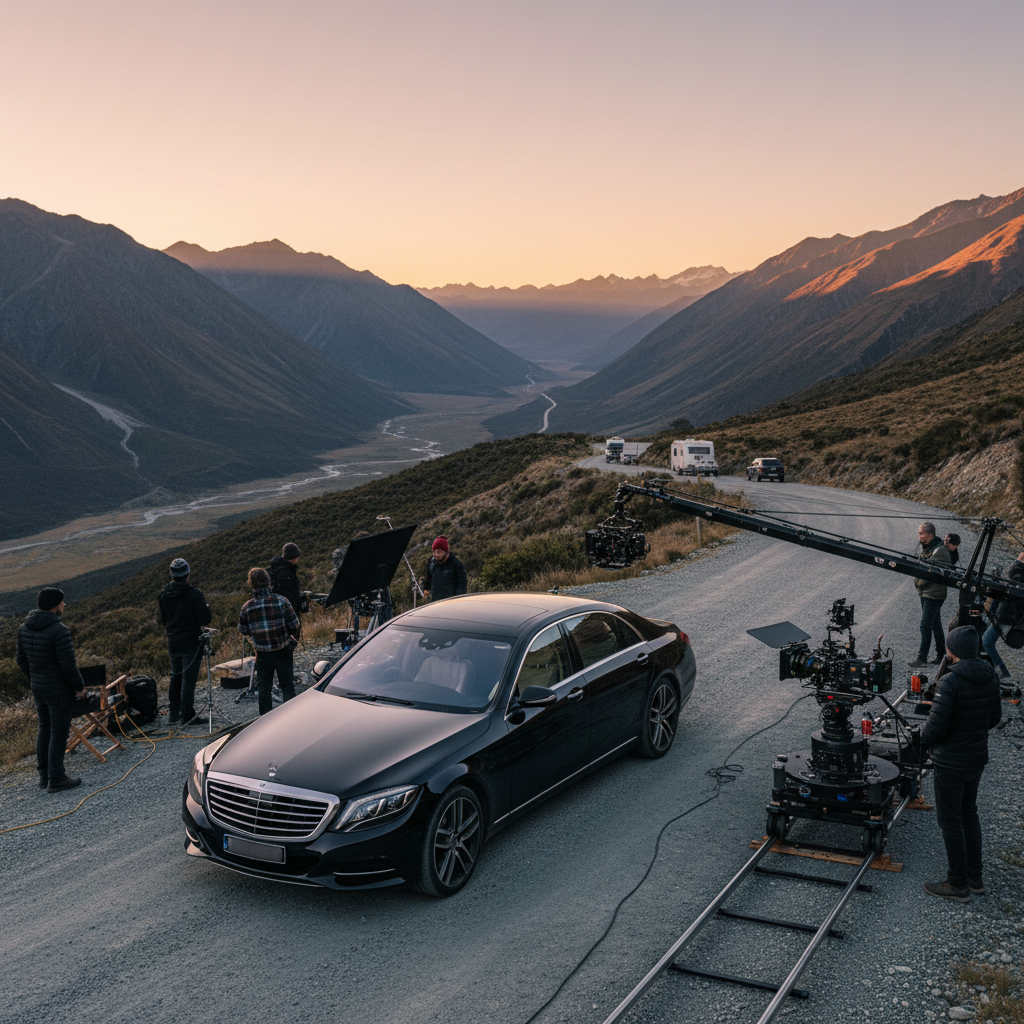
New Zealand's screen production industry runs on precision timing, remote locations, and zero tolerance for delays. Whether you're managing a Netflix series in Queenstown, a feature film unit in Fiordland, or a commercial shoot across Auckland's urban and rural locations, production transport is not a nice-to-have—it's a critical path dependency.
When international talent arrives on a 6am flight expecting departure-ready vehicles, when your second unit needs simultaneous collection from three different accommodation properties, or when weather shifts your shoot location 90 minutes south with four hours' notice, the transport operator you've contracted becomes part of your production infrastructure.
This is not rideshare territory. It's not a job for local taxi dispatch or a sole operator with two vehicles and a mobile phone. Screen production logistics require operational scale, geographic coverage, fleet depth, and the systems maturity to execute complex, multi-city movement schedules without escalation to your line producer.
What Film and Television Production Transport Actually Involves
Production transport sits outside the usual corporate transfer or airport shuttle category. The operational profile is fundamentally different:
Multi-location, multi-day coordination. A single production may require simultaneous vehicle deployment across Auckland (international arrivals), Wellington (director and DOP accommodation), and Queenstown (principal photography location). Vehicles need to be pre-positioned, drivers briefed on call times, and contingency plans ready for weather delays or schedule changes.
Talent and department head movements. Lead actors, directors, cinematographers, and key crew members expect executive sedan or SUV transport as standard—discrete, comfortable, Wi-Fi equipped, with drivers who understand the difference between on-set protocol and casual conversation.
Early call times and night shoots. Production days don't follow business hours. A 4:30am hotel departure for a dawn exterior shoot, or a wrap-time pickup at 11pm from a location 40 minutes outside the city center, is routine. Your transport provider needs 24/7 dispatch capability and driver rostering depth, not a single operator working 18-hour days.
Equipment and personnel movement to remote locations. New Zealand's screen appeal is its landscapes—which means your unit is often shooting in locations with no public transport, limited cellular coverage, and access roads that eliminate standard hire vehicles from consideration. SUVs, vans, and drivers with local route knowledge become essential production assets.
Confidentiality and discretion. High-profile international talent, unreleased scripts, and commercially sensitive shoot schedules require driver NDAs, data security protocols, and operational compartmentalization. A transport provider working across multiple productions simultaneously must maintain information barriers between client engagements.
Why Single-Operator and Gig-Model Providers Create Production Risk
New Zealand has no shortage of transport operators. What it lacks is operational scale and multi-city infrastructure capable of supporting screen production logistics without creating single points of failure.
A sole operator with premium vehicles may deliver excellent service for a one-off airport transfer. But when your production books that same operator for three weeks of daily talent movements, you inherit their capacity constraints, their vehicle maintenance schedule, their fatigue management issues, and their lack of backup resources when something breaks.
Gig-economy rideshare drivers—even those operating under chauffeur branding—are contractors with variable service standards, no production-specific briefing, and no operational oversight beyond app-based ratings. They are not background-checked to production security standards, they are not bound by confidentiality frameworks, and they cannot be rostered as reliable, repeatable resources across a multi-week shoot schedule.
When your 1st AD is managing 120 people on location and your transport no-shows or arrives 30 minutes late, you don't have a service complaint—you have a production delay with five-figure cost implications.
The Operational Requirements for Reliable Production Transport
Screen production logistics require a transport provider with specific operational capabilities that distinguish genuine nationwide operators from local vendors:
Fleet depth and vehicle staging. A production requiring four simultaneous vehicles in Queenstown and two in Auckland cannot be serviced by an operator with six cars and hope. It requires dedicated fleet allocation, geographic pre-positioning, and reserve vehicles for breakdown or schedule changes.
Driver rostering and fatigue management. Early calls, late wraps, and multi-day shoots require driver rotation, fatigue monitoring, and compliance with transport work-time regulations. This is not a problem a single operator can solve by working longer hours—it requires rostering infrastructure and employment depth.
24/7 dispatch and real-time communication. Production schedules change. Weather moves call times. Talent flights delay. Your transport provider needs live dispatch capability, direct driver communication, and real-time route adaptation—not a voicemail message and a callback in three hours.
Multi-city coordination without handoffs. A production shooting in Auckland, Wellington, and Queenstown across six weeks does not want to contract three different local operators, manage three sets of invoices, and brief three separate teams on talent protocols. They want one contract, one point of contact, and consistent service standards nationwide.
Insurance, compliance, and production-specific documentation. Production companies and their insurers require certificate of currency, public liability coverage, driver vetting records, and vehicle compliance documentation. A professional production transport provider delivers this as standard onboarding, not special requests.
Legacy EPT's Operational Footprint Across New Zealand's Screen Production Regions
Legacy EPT operates the only genuinely nationwide private transport infrastructure in New Zealand, with owned fleet and employed driver resources in Auckland, Wellington, Christchurch, and Queenstown—the four primary production hubs for international and domestic screen work.
This is not a broker model. It's not a franchise network. It's not a gig platform with independent contractors. Legacy EPT owns its vehicles, employs its drivers, and operates its own dispatch and coordination systems across every major production region in the country.
When a Netflix production books talent transport across Auckland and Queenstown simultaneously, it's the same operator, the same service protocols, the same vehicle standards, and the same duty of care framework. No handoffs. No third-party coordination gaps. No variability in driver briefing or confidentiality standards.
Fleet capability includes executive sedans (Mercedes-Benz E-Class, BMW 5 Series), luxury SUVs (Mercedes-Benz V-Class, late-model Highlander and similar), and passenger vans for crew movements and department heads traveling together. All vehicles are maintained to manufacturer service schedules, presented in immaculate condition, and equipped with connectivity and comfort features expected by international talent.
Legacy EPT's operational scale supports multi-vehicle, multi-location, multi-week production bookings without capacity strain, driver fatigue issues, or the operational fragility that comes from depending on a single individual's availability.
What Production Coordinators and Line Producers Should Require from Transport Providers
If you're managing production logistics for a feature, series, or commercial shoot in New Zealand, your transport provider should meet these baseline operational standards:
- Confirmed fleet allocation for your production dates, with named backup vehicles in case of breakdown
- Driver vetting and NDA execution before any talent or crew contact
- 24/7 dispatch contact with direct driver communication and real-time ETA updates
- Multi-city coordination capability if your production spans regions, without vendor handoffs
- Transparent invoicing with per-vehicle, per-day, or per-transfer pricing and no surprise surcharges
- Certificate of currency and compliance documentation provided during contracting, not requested afterward
These are not premium service features. They are baseline operational hygiene for professional production transport. If your current provider cannot deliver them, you are operating with unmitigated production risk.
Moving Talent and Crew With the Reliability Your Production Schedule Demands
Screen production in New Zealand happens in some of the most spectacular and logistically complex locations in the world. Your transport provider is not a peripheral vendor—they are embedded infrastructure that determines whether your shoot day starts on time, whether your talent arrives calm and prepared, and whether your multi-location unit moves efficiently between setups.
Legacy EPT works with production coordinators, line producers, and location managers to deliver predictable, professional, nationwide talent and crew logistics that don't create surprises, don't require escalation, and don't appear in your daily production report as a problem item.
If your next production requires transport capability that matches the operational standards of your camera, lighting, and post-production partners, view our Services or request a quote with your production dates and location requirements.