
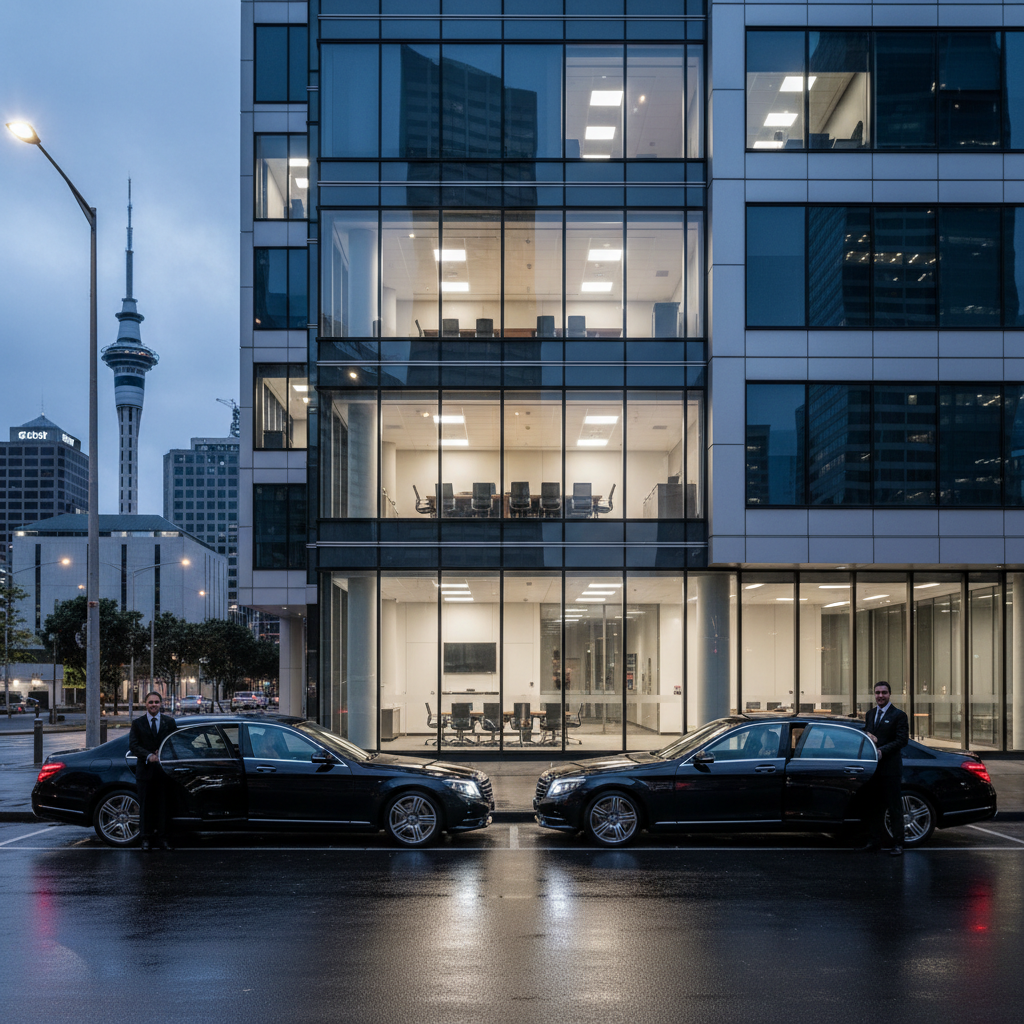
When evaluating premium ground transport providers in New Zealand, procurement teams and travel managers frequently encounter Hughes Chauffeur NZ during their research. Understanding what sits behind the brand name—and how operational models differ across the market—matters significantly when reliability, scale, and service consistency drive your decision criteria.
This comparison examines two distinct approaches to the New Zealand chauffeur market: the international franchise model represented by Hughes Chauffeur NZ, and the integrated national operator model that defines Legacy EPT's market position.
The Hughes Chauffeur Model: Franchise vs Owned Operations
Hughes Corporate is an established international chauffeur brand operating through franchise and partner arrangements across multiple countries. In New Zealand, Hughes Chauffeur NZ operates as a local franchisee—essentially an independent operator licensed to use the Hughes brand name, systems, and marketing materials.
The franchise model delivers certain advantages: established brand recognition, access to international booking platforms, and standardised operational procedures. For clients booking through international corporate travel programmes, the Hughes name offers familiarity and perceived continuity across markets.
The model also introduces structural limitations. Franchisees operate with local fleet resources, local driver networks, and local capital constraints. The Hughes Chauffeur NZ operation functions as a small-to-medium local provider with access to international branding rather than an owned national network. This distinction becomes material when your requirements extend beyond single-city, advance-booked transfers to genuine multi-location capability, fleet depth, or same-day operational flexibility.
Franchise agreements typically impose revenue-sharing arrangements, technology licensing fees, and brand compliance costs—overheads that don't exist in a vertically integrated operator model. These structural costs flow through to either pricing or operational reinvestment capacity.
Operational Scale and Geographic Coverage
Hughes Chauffeur NZ operates primarily from Auckland with service extension through subcontractor networks in other centres. The operational footprint reflects a typical franchise structure: owned capability in one market, affiliate arrangements elsewhere.
For Auckland-only requirements or pre-arranged airport transfers, this model functions adequately. Challenges emerge when your programme requires:
- Multi-city coordination across Auckland, Wellington, Christchurch, and Queenstown
- Consistent fleet standards and presentation across locations
- Real-time operational visibility across regions
- Direct accountability through single operational command
- Same-day or short-notice deployment in secondary centres
Legacy EPT operates as New Zealand's only genuinely nationwide premium transport operator with owned operations across all primary and secondary markets. The distinction isn't semantic—it's structural. Legacy EPT maintains dedicated fleet assets, employed driver teams, and direct operational control in Auckland, Wellington, Christchurch, Queenstown, Hamilton, Tauranga, Rotorua, Napier, New Plymouth, Nelson, and Dunedin.
This operational architecture delivers material advantages for corporate clients, destination management companies, and government agencies managing complex, multi-location transport programmes. When your CEO's schedule spans Auckland meetings, Wellington stakeholder engagement, and Queenstown strategic planning within 72 hours, the difference between owned national operations and franchise-plus-subcontractors becomes immediately evident.
Fleet Composition and Vehicle Standards
Fleet composition reveals operational philosophy and capital investment capacity. Franchise operators typically maintain core fleet sufficient for predictable demand, supplementing with hire vehicles or subcontractor arrangements during peak periods.
Hughes Chauffeur NZ operates a modest fleet of premium sedans—primarily European marques suitable for executive transfer work. Vehicle presentation meets international Hughes brand standards, which mandate specific cleanliness, maintenance, and presentation criteria.
Legacy EPT's Fleet represents the country's most comprehensive premium transport inventory: over 120 vehicles spanning Mercedes-Benz E-Class and S-Class sedans, V-Class people movers, Sprinter microbuses, and luxury coaches up to 48-seat capacity. The fleet includes specialised capability—wheelchair-accessible vehicles, luxury SUVs for alpine and rural terrain, and presentation vehicles for diplomatic and VVIP work.
Fleet depth determines operational resilience. When a vehicle experiences mechanical issues, when client requirements change last-minute, or when simultaneous bookings exceed baseline capacity, depth matters. A 5-vehicle operation stretches thin quickly. A 120-vehicle fleet absorbs variability without service degradation.
Technology Platform and Booking Integration
International franchise brands typically provide proprietary booking and dispatch technology as part of the franchise package. Hughes Chauffeur franchisees access global reservation systems, mobile apps, and corporate client portals developed by the parent organisation.
This technology stack delivers consistency across international Hughes operations—a Sydney booking looks and feels identical to an Auckland booking from the client interface perspective. Behind the interface, local operational capacity determines actual service delivery.
Legacy EPT developed its technology platform specifically for New Zealand's geographic and operational requirements. The system integrates real-time fleet management, driver dispatch, client communication, and billing across all locations through unified architecture. Corporate clients access online booking portals with company-specific rate structures, approval workflows, and consolidated reporting across all locations and divisions.
For travel managers operating corporate ground transport programmes, technology architecture directly impacts reporting capability, cost allocation, and policy compliance monitoring. Proprietary systems built for local requirements typically outperform adapted international platforms when operational complexity increases.
Pricing Structure and Cost Transparency
Franchise models carry inherent cost structures—royalty payments, technology licensing fees, brand fees, and marketing fund contributions flow from franchisee to franchisor. These costs sit above operational expenses (fleet, drivers, insurance, fuel, maintenance) and administrative overhead.
Hughes Chauffeur NZ pricing reflects these layered costs while maintaining competitive positioning in the Auckland market. Rates for standard executive sedan service typically sit within market range for premium providers, with premiums applied for brand recognition and international booking integration.
Legacy EPT's integrated operator model eliminates franchise fees and revenue-sharing arrangements. Pricing reflects direct operational costs, fleet capital amortisation, technology development, and margin. For corporate clients managing ground transport as a managed category, cost structure transparency informs total cost of ownership calculations beyond per-trip rates.
Volume-based pricing, multi-location rate harmonisation, and annual contract structures become viable when the operator controls all operational levers without franchise agreement constraints.
Corporate Client Service and Account Management
Small franchise operations typically handle account management through owner-operators or small administrative teams. Responsiveness can be high; strategic capability and operational redundancy face natural constraints.
Legacy EPT maintains dedicated corporate account management across sectors—corporate and government clients receive assigned account directors who coordinate requirements across all locations, manage complex multi-day programmes, and provide single-point accountability regardless of operational complexity.
For procurement teams evaluating supplier capability, account management structure, escalation protocols, and operational redundancy represent material evaluation criteria alongside price and vehicle quality.
The Verdict: Franchise Brand vs Integrated National Operator
Hughes Chauffeur NZ represents a competent Auckland-based franchise operation offering premium sedan service under an established international brand. For straightforward Auckland airport transfers or single-city executive transport, the service delivers adequately.
The franchise model's limitations emerge when your requirements demand genuine national capability, operational depth, fleet diversity, or complex programme coordination. International branding doesn't substitute for owned multi-location operations, fleet scale, or integrated command and control.
Legacy EPT operates as New Zealand's only true nationwide premium transport operator—not through franchise agreements or subcontractor networks, but through owned operations, dedicated fleet assets, and employed driver teams across every significant market in the country.
When your transport requirements extend beyond basic transfers to strategic capability—reliability, scalability, operational visibility, and genuine national reach—the choice becomes clear.
Ready to compare capability directly? Request a detailed capability statement and rate proposal through our Quote page or speak with our corporate team via Contact to discuss your specific requirements across any New Zealand location.