
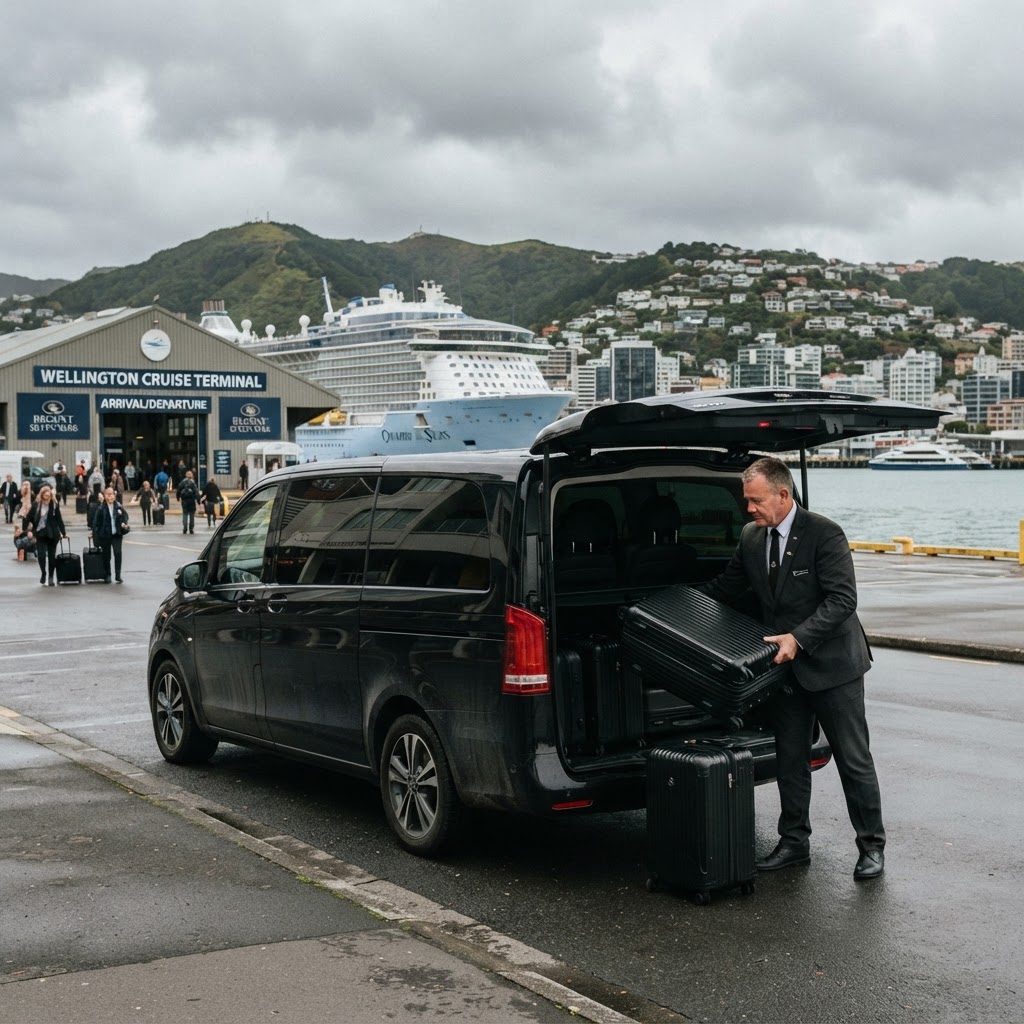
Luggage-Friendly Private Van Transfers: Wellington Airport to Cruise Terminal
The Wellington Airport to cruise terminal transfer is deceptively challenging. It's only 6.2 kilometres by road, but when you're moving four to seven passengers with full cruise luggage—two large checked bags per person, carry-ons, duty-free purchases, winter coats for southern itineraries—the standard sedan or SUV becomes immediately inadequate.
Most travellers discover this at the worst possible moment: standing at the terminal kerb with seven bags stacked on two trolleys, watching a booked "executive sedan" pull up with boot space for exactly three suitcases.
This article maps the actual vehicle and logistics requirements for luggage-heavy airport-to-cruise transfers in Wellington, the operational differences between vehicle classes, and what separates genuine van capacity from vehicles marketed as "spacious."
Why Wellington cruise transfers have higher luggage demands than standard airport runs
Cruise embarkation and disembarkation generate the highest per-passenger luggage volumes in private transport. Unlike hotel transfers where bags can be couriered separately or business travel where carry-on is standard, cruise passengers travel with their entire voyage wardrobe for 10–90 day itineraries.
A typical Wellington cruise transfer profile:
- Two large checked bags per passenger (23kg each, wheeled hard-shell cases averaging 75cm height)
- One carry-on bag or backpack per passenger
- Duty-free purchases from origin airport (often Singapore, Sydney, Melbourne for inbound international cruise joiners)
- Jackets, medication bags, electronics
- Occasionally mobility aids, CPAP machines, or special dietary supplies for long voyages
For a family of four, that's eight large bags, four carry-ons, plus ancillary items. For a group of six, you're moving twelve checked bags alone.
The standard premium sedan (BMW 5 Series, Audi A6, Mercedes E-Class) has boot capacity for three to four large bags maximum. Adding roof storage isn't viable for cruise transfers—passengers won't check in to a ship with bags that have been exposed to road grit and weather for 15 minutes on State Highway 1.
The only legitimate solution is a properly configured multi-passenger van with dedicated luggage capacity or a vehicle-and-trailer combination operated by a driver certified for towing in commercial passenger service.
Vehicle categories: actual luggage capacity vs. marketed passenger count
Wellington's private transport market lists "vans" and "people movers" with widely varying real-world capability. Here's the operational breakdown:
7-Seat SUVs (Toyota Highlander, Mazda CX-9, Hyundai Palisade)
Marketed capacity: 7 passengers
Actual cruise transfer capacity: 4 passengers + luggage, or 6 passengers + minimal bags
Limitation: Third-row seating eliminates boot space entirely. Folding third row restores luggage area but reduces seating to five.
8-Seat Vans (Hyundai iMax, Kia Carnival)
Marketed capacity: 8 passengers
Actual cruise transfer capacity: 5–6 passengers + full cruise luggage
Limitation: Rear luggage area adequate for 10–12 bags only when third row is folded or removed. Comfortable seating with luggage: six passengers maximum.
Mercedes V-Class (Long Wheelbase)
Marketed capacity: 7 passengers
Actual cruise transfer capacity: 6 passengers + 12–14 large bags
Advantage: Flexible seating configuration, rear climate control, independent luggage compartment when configured correctly, electric side doors for tight cruise terminal loading zones.
11–13 Seat Minibuses (Toyota Hiace, Mercedes Sprinter)
Marketed capacity: 11+ passengers
Actual cruise transfer capacity: 8–10 passengers + full luggage with rear seats folded
Advantage: Genuine cargo volume. Cruise-optimal when operated with 10 passengers and rear quarter configured for baggage.
Vehicle + Enclosed Trailer
Capacity: 7 passengers + luggage for 10–12 people in weatherproof trailer
Limitation: Requires certified towing endorsement on commercial driver licence. Not all operators hold this. Adds 4–6 minutes to transfer time. Not viable for certain cruise terminal access points with tight turning circles.
The real-world standard for Wellington cruise groups of 4–7 passengers is the long-wheelbase van with flexible seating, not a stretched SUV or minibus running half-empty.
Wellington Airport to cruise terminal: route, timing, and kerb logistics
The transfer runs from Wellington Airport's domestic or international terminal (both on Stewart Duff Drive) to Queens Wharf Interislander Ferry Terminal (where most cruise ships dock) or Aotea Quay Outer T (for larger vessels).
Route
Via Cobham Drive and Waterloo Quay: 6.2 km, 12–15 minutes off-peak, 18–22 minutes during weekday AM peak (7:30–9:00 AM) or when cruise ship and Interislander ferry schedules align.
Terminal pickup logistics
International arrivals: Passenger exit is on the northern end of the terminal. Van loading occurs kerbside on Stewart Duff Drive. Luggage volume makes trolley-to-vehicle transfer the slowest part of the journey—allow 8–10 minutes for six passengers with full cruise baggage.
Domestic arrivals: Faster kerb access, smaller arrival surges. Still allow 6–8 minutes load time for luggage-heavy groups.
Cruise terminal drop-off
Queens Wharf: Vehicles enter via Waterloo Quay, turning into the terminal access road. Passenger drop is immediately adjacent to check-in marquees. Luggage is unloaded kerbside; passengers wheel bags 15–30 meters to check-in depending on vessel.
Aotea Quay: Larger dedicated cruise facility. Vehicle access controlled by port authority during embarkation windows. Drop-off directly alongside gangway security check. Easier for mobility-limited passengers.
The critical operational requirement: vehicle access to within 10 meters of check-in. This is why rideshare and shuttle services often fail cruise transfers—drivers unfamiliar with port access protocols are directed to general drop-off zones 100+ meters from ship check-in.
What to confirm when booking a luggage-heavy transfer
When booking private van transport for Wellington Airport to cruise terminal, confirm these five specifications to avoid vehicle-capacity mismatches:
- Exact passenger count and per-person bag count
"We have five passengers, ten large suitcases, five carry-ons" is more useful than "we need a van." - Vehicle make and model, not just "luxury van"
A Hyundai iMax and a Mercedes V-Class LWB are both vans. Luggage configuration and passenger comfort differ significantly. - Luggage configuration method
Will bags fit in a dedicated luggage compartment, or will third-row seats be folded? (The latter reduces passenger comfort and increases load/unload time.) - Driver cruise terminal experience
Has the driver operated cruise transfers at Queens Wharf or Aotea Quay specifically? Port security and vehicle routing aren't intuitive. - Contingency for oversized or additional bags
What happens if your group has 14 bags instead of the estimated 12? Is a second vehicle dispatched, or is a trailer available?
Operators with genuine van fleet depth can adjust vehicle assignment up to 24 hours before pickup. Single-vehicle operators cannot—they'll either show up with inadequate capacity or cancel.
Why this transfer type reveals operational scale
The Wellington Airport to cruise terminal transfer is a fleet stress test. It requires:
- Vehicle availability with 48–72 hours' notice during cruise season (October–April)
- Correct vehicle class assignment based on luggage specifications, not just passenger count
- Driver familiarity with port authority access procedures
- Flexibility to adjust vehicle size if passenger count or luggage volume changes
Small operators—particularly those running one or two vehicles under a brand name—cannot reliably deliver this. If their single V-Class is committed to a Queenstown airport run when your cruise transfer is requested, you'll receive a "fully booked" response or be pushed to a less suitable vehicle.
Operators with dedicated Wellington fleet resources and multi-city operational scale can resource these transfers from vehicle pools that include multiple van configurations, backup units, and drivers who run cruise terminal transfers weekly during season.
Legacy EPT operates dedicated fleet resources in Wellington with long-wheelbase vans, minibuses, and vehicle-trailer combinations specifically maintained for luggage-intensive cruise, conference, and group transfers. Vehicle assignment is demand-matched to actual bag count and passenger profile, not generic "van" categories.
For groups connecting between flight and ship in Wellington, particularly international visitors joining Pacific or Fiordland cruise itineraries, the difference between a correctly specified transfer and a kerb-side scramble comes down to operational depth, not marketing promises.
Request a luggage-specific vehicle quote with bag count and passenger details at wearelegacy.co.nz/Quote, or reach our Wellington team directly at wearelegacy.co.nz/Contact.
Frequently Asked Questions
How far is Wellington Airport from the cruise terminal?
The transfer runs approximately 6.2 kilometres via Cobham Drive and Waterloo Quay — 12–15 minutes off-peak and 18–22 minutes during weekday AM peak (7:30–9:00 AM) or when cruise ship and Interislander ferry schedules align. Most cruise ships dock at Queens Wharf, with larger vessels using Aotea Quay Outer T.
What vehicle is best for a Wellington cruise transfer with luggage?
For groups of 4–7 passengers with full cruise luggage, a long-wheelbase van such as a Mercedes V-Class LWB is the real-world standard. It carries 6 passengers plus 12–14 large bags with a dedicated luggage compartment, electric side doors for tight terminal loading, and rear climate control. Standard sedans and 7-seat SUVs lack the boot space for cruise baggage volumes.
Can a van carry both passengers and full cruise luggage?
It depends on configuration. A Mercedes V-Class LWB can carry 6 passengers with 12–14 large bags in a dedicated compartment. 8-seat vans like the Hyundai iMax or Kia Carnival manage 5–6 passengers with full luggage only when the third row is folded. 7-seat SUVs fit 4 passengers with luggage or 6 with minimal bags because third-row seating eliminates boot space.
How do drivers access the Wellington cruise terminals?
Queens Wharf is accessed via Waterloo Quay and the terminal access road, with kerbside drop immediately adjacent to check-in marquees. Aotea Quay is a larger dedicated facility with port-authority-controlled access during embarkation windows and drop-off directly alongside gangway security. Drivers unfamiliar with port access protocols are often directed to general drop-off zones 100+ metres from ship check-in.
What should I confirm when booking a luggage-heavy cruise transfer?
Confirm exact passenger and per-person bag count, vehicle make and model (not just 'luxury van'), luggage configuration method, driver cruise terminal experience at Queens Wharf or Aotea Quay specifically, and contingency for oversized or additional bags. Operators with genuine van fleet depth can adjust vehicle assignment up to 24 hours before pickup; single-vehicle operators cannot.
Catherine Holloway
Partnership Development · Based in Auckland
Catherine leads trade and partnership development for Legacy EPT, working with DMCs, ITOs, and cruise coordinators across New Zealand. She specializes in group logistics and multi-modal transport solutions for international visitors.