
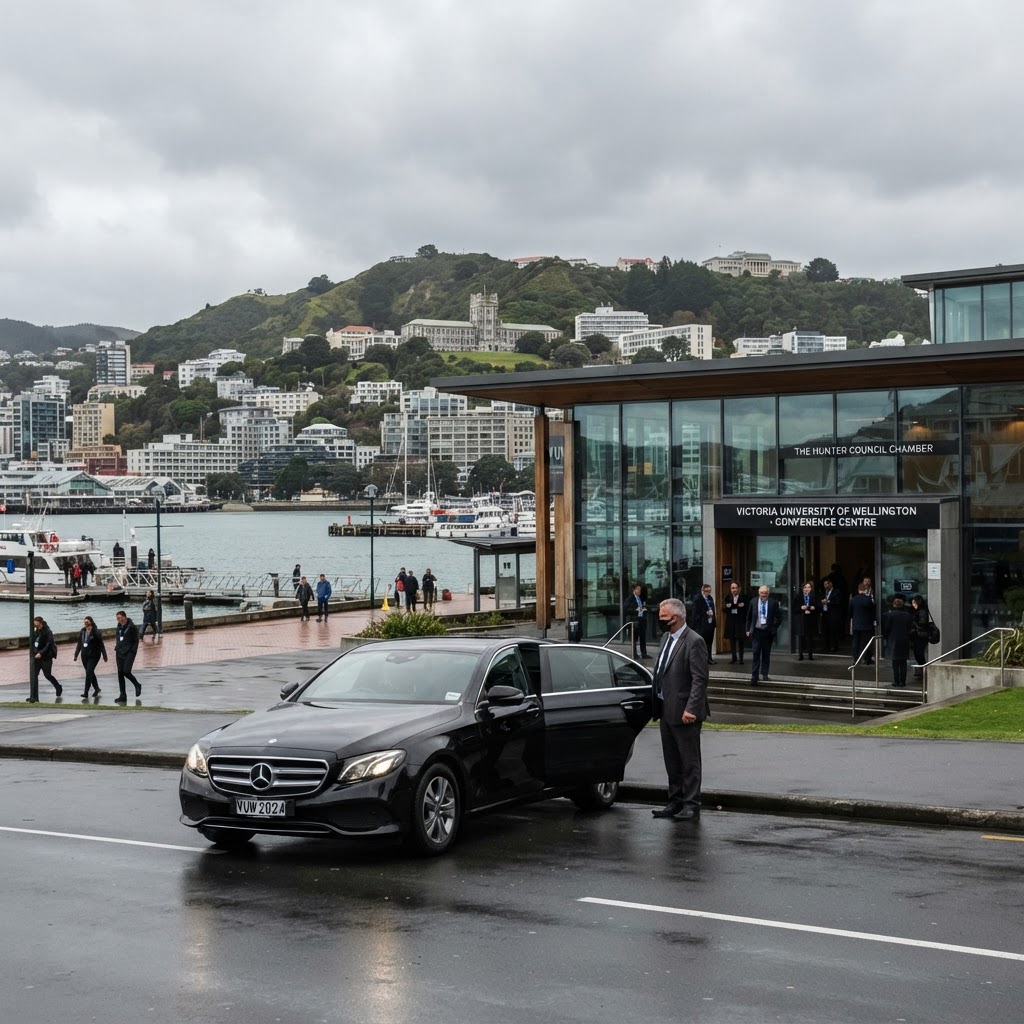
Private Transport for International Academic Conferences in Wellington
iConference 2027
22 March - 9 April 2027 (unconfirmed)
Information sciences / academic congress
Ground transport planning for distributed academic events
When an international academic conference brings hundreds of researchers, keynote speakers and institution delegates into Wellington - particularly one structured across virtual and in-person phases, or spanning multiple university venues - the ground transport layer needs to function as operational infrastructure, not ad-hoc taxi bookings.
Legacy operates a European fleet with employed professional drivers across New Zealand's conference cities, including Wellington. The platform is built around the realities of academic events: staggered international arrivals, fluid venue schedules, keynote movements between campuses, and the expectation that a Victoria University of Wellington coordinator can see where a delayed speaker's vehicle is without making a phone call.
This post addresses the transport planning considerations for events of this structure and scale, using iConference 2027 - expected to draw the global iSchools community to Wellington in early 2027 - as the reference case.
Why academic conferences break consumer transport models
University-hosted conferences present a distinct logistics profile. Delegates arrive across a 48-72 hour window from long-haul origins: North America, Europe, Asia-Pacific. Flight delays are structurally common. Accommodation is distributed - some delegates book campus-adjacent hotels, others stay in the city centre, and visiting faculty may be hosted in university lodges or private arrangements.
Consumer ride apps work acceptably for a single trip with margin for error. They falter when you need 40 airport pickups coordinated to actual landing times, or when a keynote speaker's Auckland connection is delayed two hours and the venue team needs to know the adjusted ETA without chasing a driver's mobile number.
Legacy's operations platform monitors international flight status in real time. When an academic delegate's SFO-AKL-WLG routing slips, the system adjusts the driver dispatch window automatically. The conference organiser sees updated pickup timing through their account portal; the driver receives the change through the dispatch app. No one is stranded at Wellington Airport at 23:00 waiting for a ride that was booked for 19:30.
This is not concierge service for its own sake. It is operational hygiene for events where reputational risk sits with the host institution, and where the person booking transport is accountable to a dean or conference committee.
Multi-venue, multi-day coordination
Academic conferences increasingly use hybrid structures: virtual sessions in the lead-up, in-person intensives across university lecture theatres, social functions at civic or waterfront venues, and post-conference workshops at partner institutions. iConference 2027's provisional structure - a virtual phase followed by an on-site phase across Victoria University of Wellington and a partner campus - exemplifies this.
From a transport perspective, this means:
The fleet requirement is not a single-day peak, but sustained multi-day coverage with variable daily demand. A professional transport operator holds vehicle and driver capacity across the event window. Marketplace platforms cannot do this - they rely on whatever driver supply happens to be online at the moment of request.
Movement is not just airport-to-hotel. It includes scheduled shuttles between campus buildings, ad-hoc executive vehicles for keynote speakers moving between commitments, evening transfers to civic reception venues, and return coordination at close of programme when 150 people need to reach Wellington Airport within a compressed departure window.
Route knowledge matters. Wellington's street grid, one-way system, university campus access points, and the distance relationships between Kelburn campus, the railway station precinct, and the airport are not self-evident to a visiting academic. Employed drivers who work these routes daily as part of a professional fleet deliver materially better service than a gig driver unfamiliar with university pickup protocols.
Fleet composition and vehicle assignment
A 200-300 delegate academic congress does not require a uniform vehicle type. The transport mix reflects role and party size: sedans and SUVs for individual keynote transfers, larger vans for delegation moves, and potentially minibuses for scheduled campus shuttles if the venue layout or accommodation spread justifies it.
Legacy operates a European fleet sized and specified for professional transport work. Vehicle assignment is managed through the dispatch platform, not left to random driver acceptance. When a conference organiser requests an executive sedan for a visiting professor and a seven-seat van for a research group, those requests are fulfilled as specified.
This is a function of fleet ownership. A marketplace aggregator cannot enforce vehicle type because it does not own the vehicles. An operator with an owned fleet can.
Account management and institutional billing
Universities and academic conference committees operate within institutional procurement frameworks. They require upfront quotes, purchase order accommodation, consolidated invoicing, and an audit trail.
Legacy's B2B structure is built for this. Each conference or institution is set up as a managed account. All movements - whether booked by the conference secretariat, individual faculty leads, or the vice-chancellor's office - roll into a single consolidated invoice post-event. There is no per-trip credit card fragmentation, no reconciliation of 60 individual ride receipts.
For a multi-day, multi-stakeholder event, this is not a convenience feature. It is a structural requirement.
Booking lead time and contingency access
Academic conferences are planned 12-24 months ahead. Venue contracts are signed, keynote speakers confirmed, and delegate registrations open long before the event moves into operational delivery.
Ground transport should be locked in at the same planning horizon. Legacy works with conference organisers and university events teams from the point where dates and rough delegate numbers are known. Provisional fleet allocation is made; adjustments are managed as delegate numbers firm up. The alternative - attempting to secure vehicle capacity four weeks before a 300-person congress - introduces unnecessary execution risk.
Equally important: contingency access during the event. A conference organiser needs a phone number that reaches the dispatch desk directly, not a consumer app helpline in another country. When a delegate misses their transfer or a session runs late and the afternoon shuttle needs to be pushed 30 minutes, resolution needs to happen in a single call, not through an in-app chat queue.
Wellington as a conference city
Wellington's compact geography, accessible international airport, concentration of government and research institutions, and quality venue and accommodation infrastructure make it a natural host for academic and professional congresses. Te Papa, the Michael Fowler Centre, and university facilities including Victoria University's Kelburn and Pipitea campuses provide the physical event layer.
The transport layer underneath that infrastructure needs to function with the same professionalism. For international delegates whose entire New Zealand experience may be a three-day conference window, ground transport is not incidental - it is the first and last operational touchpoint, and it carries institutional reputation.
Legacy provides that layer: owned fleet, employed drivers, real-time flight coordination, account-managed billing, and dispatch capability across the event duration. The platform is built for professional transport work at scale, and it operates in Wellington and every other New Zealand city where conferences of this type take place.
Contact Legacy to discuss academic conference transport in Wellington, or request a quote for your iConference 2027 transport plan.
Frequently Asked Questions
How far is Victoria University of Wellington Kelburn campus from Wellington Airport?
Victoria University's Kelburn campus is approximately 8 kilometres from Wellington Airport, typically a 15-20 minute drive depending on time of day and traffic through the airport tunnel and city centre. Legacy drivers are familiar with campus access points and drop-off protocols for conference and university events.
Can Legacy handle staggered international arrivals across a 72-hour window for a 200-delegate conference?
Yes. Legacy's operations platform monitors international flight arrivals in real time and adjusts driver dispatch timing automatically when flights are delayed. All pickups for a conference account are managed under a single coordinated booking, with consolidated billing post-event.
What vehicles does Legacy provide for keynote speaker and VIP delegate transfers in Wellington?
Legacy operates a European fleet including executive sedans and SUVs suitable for individual or small-group VIP transfers. Vehicle assignment is managed through the dispatch platform to match the requested specification, and all drivers are employed professionals familiar with Wellington's university and civic venue locations.
Does Legacy provide scheduled shuttle services between multiple conference venues in Wellington?
Yes. For multi-venue conferences requiring scheduled transfers between university campuses, hotels, and civic venues, Legacy can provision dedicated shuttle vehicles with employed drivers operating on a fixed timetable. All movements are coordinated through the same dispatch platform used for individual transfers.
How does billing work for a university-hosted conference with multiple booking stakeholders?
Legacy sets up each conference as a managed account. All transfers - whether booked by the conference secretariat, individual faculty, or institution executives - are consolidated into a single post-event invoice. This supports institutional procurement requirements including purchase orders and audit trail documentation.
Rob Snelling
CEO · Strategy, capability, fleet and client relationships · Legacy EPT
Rob Snelling is CEO of Legacy, with over a decade in New Zealand's premium tourism and ground-transport sector. He leads Legacy's strategy, capability, and client relationships, with a particular focus on the operational technology and fleet investment that sets the company apart from marketplace alternatives.