
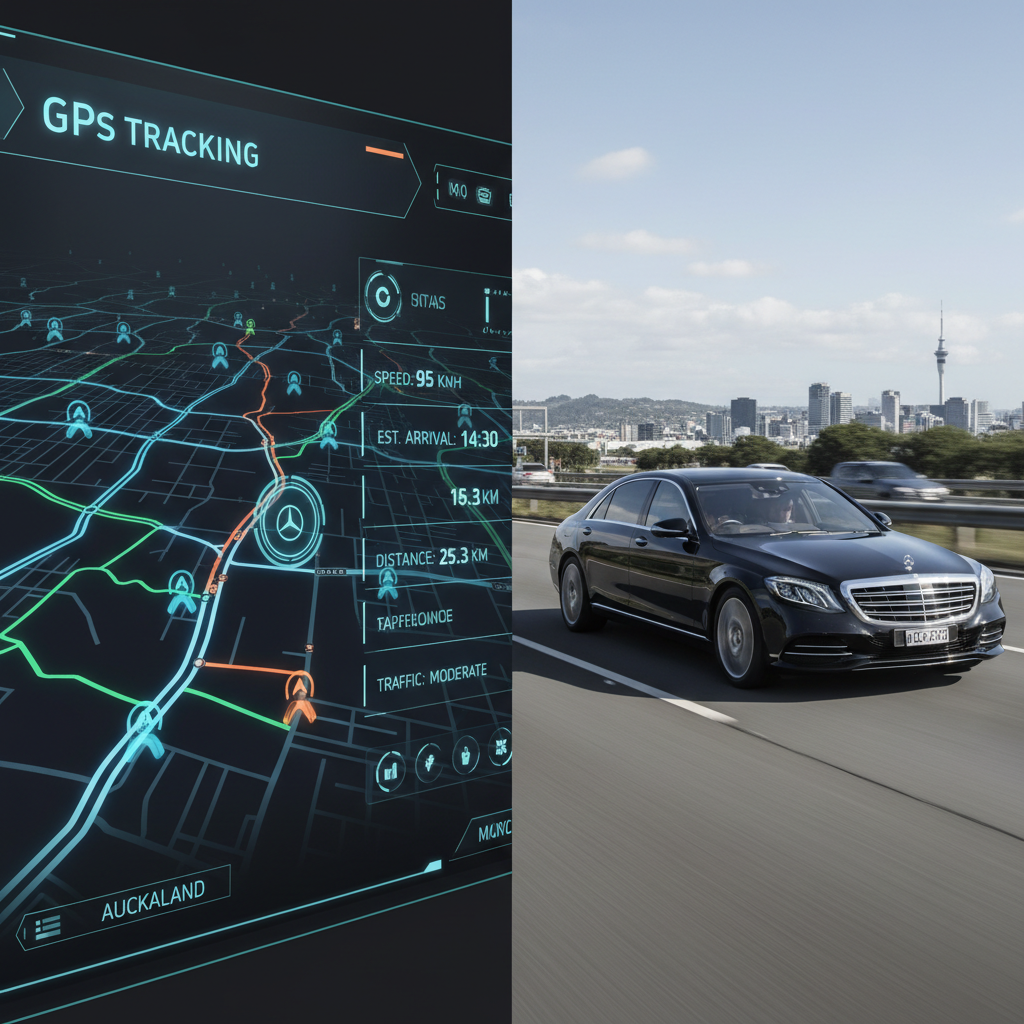
When a destination management company books 14 airport transfers across three cities for a single inbound group, or a corporate travel manager schedules overlapping pickups for back-to-back meetings, the technical question isn't whether vehicles will arrive—it's whether the booking agent has real-time operational visibility to manage client expectations, respond to flight delays, and coordinate handovers without calling dispatch every ten minutes.
In New Zealand's private transport sector, "tracking" means wildly different things. Some operators offer post-trip GPS reports. Others provide driver mobile numbers and ask agents to text for updates. A handful use consumer ride-share interfaces retrofitted for corporate use. Only enterprise-grade transport operators provide genuine real-time tracking with API integration, geofenced alerts, and agent-accessible dashboards that function as operational tools rather than marketing features.
This post examines what real-time vehicle tracking actually requires at scale, the technical standards booking agents should demand, and how tracking infrastructure separates genuine fleet operators from single-vehicle services using aggregator technology.
What Real-Time Tracking Means in Fleet Operations
Real-time tracking is not a driver sharing their Google Maps location. It's a persistent telemetry feed from vehicle-mounted GPS units transmitting position, speed, route adherence, and idle time to a central dispatch system, then exposed to authorized users—agents, corporate clients, or passengers—through secure interfaces with sub-60-second refresh rates.
Minimum technical requirements:
- Hardwired GPS telemetry units in every vehicle (not driver phone apps that drop coverage or run out of battery)
- Dedicated tracking platform integrated with dispatch and booking systems
- Agent-level access permissions allowing booking partners to monitor their jobs without seeing other clients' movements
- Geofence alerts triggering notifications when vehicles enter pickup zones, depart, or experience delays
- Historical route playback for post-trip reconciliation and billing verification
The operational difference is transparency. When an agent books ten vehicles for a conference shuttle run, they need a single dashboard showing all ten units simultaneously—not ten separate driver phone numbers to chase. When a flight lands 40 minutes early in Wellington, the tracking system should confirm whether the vehicle has already departed Hutt Valley or is still stationary at a staging point.
Why Booking Agents Require Direct Tracking Access
For destination management companies, corporate travel managers, and event coordinators managing multi-leg itineraries, tracking access is risk mitigation. The agent carries the client relationship and accountability. When a corporate CEO asks their PA why the car isn't at the terminal yet, the PA calls the agent, and the agent needs an answer in seconds—not a promise to "check with the driver."
Operational scenarios where agent-level tracking is non-negotiable:
- Film production logistics: 17 talent pickups across Auckland suburbs with staggered call times; production coordinator needs live visibility on which vehicles are rolling and which are still 12 minutes out
- Cruise ship turnarounds: 40 passengers disembarking Akaroa with Christchurch Airport transfers; shore excursion manager tracking which vehicles have departed the port and which are still loading luggage
- Conference shuttle runs: Continuous loop service between venue and hotels; event manager confirming frequency adherence without calling dispatch every cycle
- VIP diplomatic movements: Government liaison officer monitoring vehicle approach to secure facility entry point with advance notification requirements
Without direct tracking access, the booking agent becomes a message relay—calling dispatch, waiting for driver contact, reporting back to the client. With tracking access, the agent becomes an informed operator managing their client's experience directly.
Fleet Scale and Tracking Infrastructure Investment
Real-time tracking infrastructure is expensive and operationally complex. Vehicle-grade GPS units cost $800–1,500 per install. Software licensing for enterprise tracking platforms runs $200–600 per vehicle monthly. Integration with booking systems, client portals, and agent dashboards requires custom development. The business case only justifies the investment at scale—typically 25+ vehicles minimum.
This is where New Zealand's private transport market fragments sharply. Single-vehicle operators and microbusinesses (1–4 cars) using driver phones and ride-share platforms cannot economically support dedicated tracking infrastructure. They rely on manual updates, SMS confirmations, and driver mobile contact—adequate for simple A-to-B airport runs, inadequate for coordinated multi-vehicle operations.
Multi-city operators with 15+ vehicles per region can justify tracking infrastructure because:
- Agent and corporate portals become competitive differentiators that win RFP requirements from large accounts
- Dispatch efficiency improves through predictive ETAs and dynamic re-routing
- Driver accountability increases with route adherence monitoring and idle time reporting
- Billing accuracy improves with GPS-verified route distances and waiting time logs
The tracking investment correlates directly with operational scale. If an operator doesn't list their fleet size publicly, doesn't specify vehicle locations by city, or uses phrases like "access to premium vehicles," their tracking capability is almost certainly driver-phone-based rather than infrastructure-based.
Integration Standards for DMC and Corporate Agent Systems
For booking agents managing high volumes—destination management companies coordinating 40+ jobs weekly, corporate travel management companies servicing multi-location accounts—API integration is the threshold requirement. Manual re-entry of booking confirmations, tracking links, and vehicle updates creates error risk and workflow bottleneck.
Modern agent-operator integration includes:
- Booking API endpoints: Agent submits job details from their TMS or CRM; operator system confirms availability, pricing, and vehicle assignment programmatically
- Webhook status updates: Automated notifications pushed to agent systems when vehicle dispatched, approaching pickup, passenger onboard, or trip completed
- Embedded tracking widgets: Live map embed the agent can surface in their own client portal without redirecting to operator site
- Consolidated reporting exports: Multi-job billing summaries, carbon emissions data, and service metrics in formats compatible with agent accounting systems
Legacy EPT operates agent-accessible tracking dashboards with customizable alert thresholds, white-label portal options for large DMC partners, and API documentation for systems integration. The tracking infrastructure runs on the same platform that manages dispatch across Auckland, Wellington, Christchurch, and Queenstown, providing agents a unified view regardless of which city their clients are traveling through.
Practical Tracking Workflow: Multi-City Inbound Group Example
Consider a 12-day New Zealand incentive program for 28 pharmaceutical executives: Auckland arrival, North Island touring, Wellington meetings, South Island scenic transfers, Queenstown departure. The DMC books 64 individual transfers and six full-day charters across four cities through a single transport operator.
Agent tracking workflow with enterprise infrastructure:
- Day 1, Auckland Airport arrival: Agent monitors inbound QF151 from Sydney (delayed 25 minutes); tracking shows all four assigned Mercedes V-Class vehicles still staged at domestic terminal; agent sends single message to dispatch requesting reposition to international; vehicles move; no client phone calls
- Day 4, Rotorua to Taupo charter: Six-vehicle convoy; agent embeds tracking widget in client's event app; program manager watches progress without involving DMC coordinator
- Day 7, Wellington Airport departure: Three vehicles assigned; one experiences motorway delay due to crash near Ngauranga; tracking triggers geofence delay alert; agent proactively notifies client and confirms other two vehicles on schedule; dispatch redirects delayed vehicle via Hutt Road; minimal impact
- Day 11, Queenstown winery run: Four vehicles on staggered schedule; agent uses historical playback post-trip to verify billing for additional wait time at Gibbston Valley when clients extended tasting
The DMC books once, monitors continuously, and reconciles accurately—without making a single chase-up phone call. The tracking infrastructure handles operational visibility; the agent manages client experience.
Vehicle Types and Tracking Hardware Compatibility
Not all tracking systems work equally across vehicle types. Luxury sedans and SUVs (Mercedes E-Class, BMW 7 Series, Audi Q7) accommodate hardwired GPS units easily with concealed antennas and integrated power. Mercedes V-Class and Sprinter vans require commercial-grade installations with secondary power backups to handle continuous operation during long charters.
Tesla Model S and Model X present unique challenges: they have native GPS tracking through Tesla's system, but integrating that proprietary data feed into third-party dispatch platforms requires custom development most operators haven't invested in. Operators using Tesla fleet vehicles should specify whether tracking runs through Tesla's system (which clients can't access) or through independent hardware integrated with their booking platform.
When evaluating transport operators for tracking capability, ask specifically: "What hardware is installed in your vehicles, and can I see a demo of the agent dashboard before booking?" Consumer-grade answers ("We use Google tracking" or "Drivers share their location") identify microbusiness operations. Enterprise answers specify hardware brands, refresh rates, and show you a working portal.
Tracking as Operational Standard, Not Premium Feature
Ten years ago, real-time tracking was a premium differentiator in private transport. Today, it's a baseline operational requirement for any operator serving corporate, government, or trade channel clients at scale. The technology cost has dropped; the integration standards have matured; client expectations have shifted from "nice to have" to "assumed included."
For booking agents evaluating transport partners across New Zealand's regions, tracking capability is a direct proxy for operational maturity. If an operator can't provide agent-level dashboard access, they're either too small to have invested in the infrastructure or using subcontractor networks they don't directly control. Both scenarios create risk when you're coordinating multi-vehicle, multi-day programs where client experience depends on operational visibility.
When you're managing 40 inbound guests across three cities with 64 scheduled movements, you need transport infrastructure that works like transport infrastructure—automated, transparent, and accessible. Legacy EPT operates dedicated fleet vehicles with integrated tracking across Auckland, Wellington, Christchurch, and Queenstown, with agent portals, API access, and white-label options for DMC partners managing high-volume programs. For a demonstration of the agent tracking dashboard or to discuss integration requirements for your booking systems, contact our trade partnerships team or request access through the Quote page.