
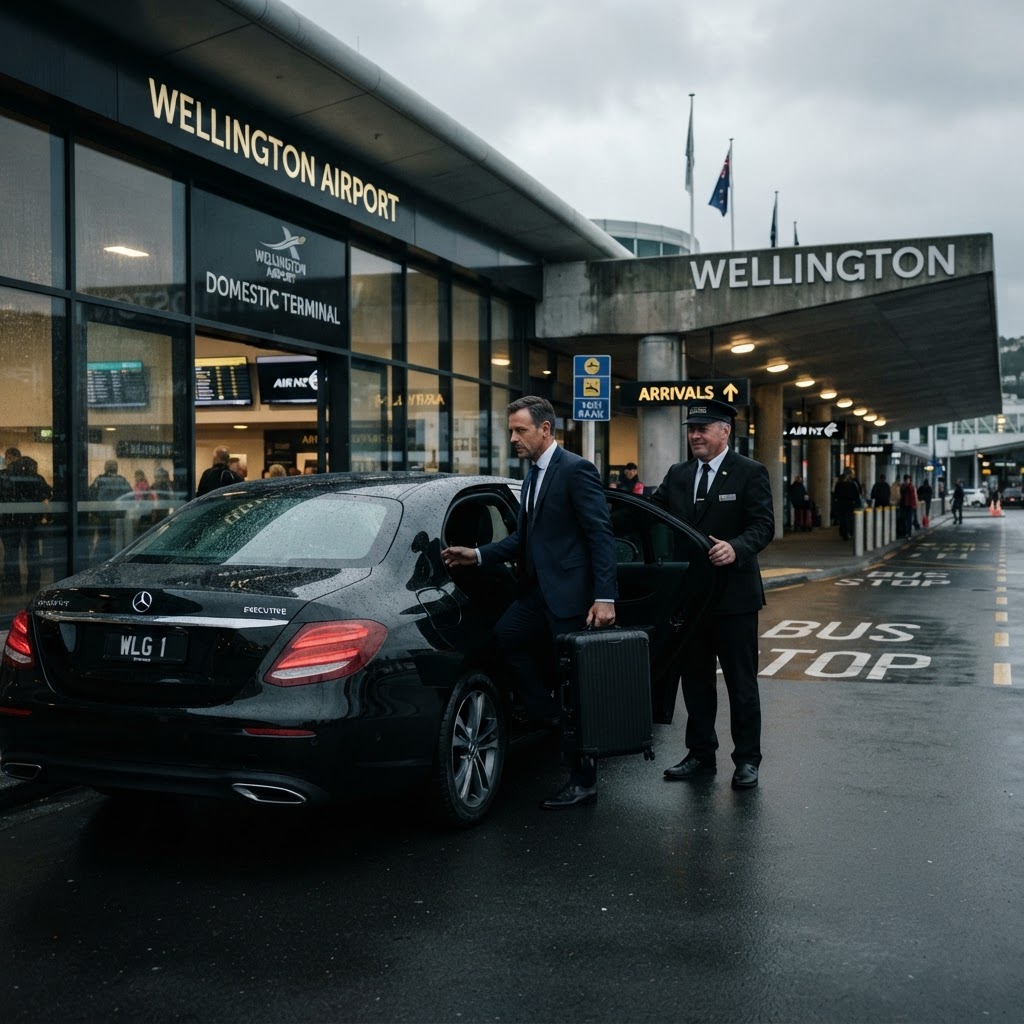
Executive Airport Transfer Wellington: Fleet, Timing and Corporate Standards Explained
Wellington Airport sits exposed on the Miramar Peninsula, and executive airport transfer Wellington operations require specific operational capability that most providers simply don't maintain. The capital's unique combination of weather disruption, compressed CBD proximity, and high-stakes passenger mix (diplomatic, ministerial, corporate C-suite) means airport transfer services need genuine fleet depth, real-time flight tracking integration, and driver capability beyond basic licensing.
This isn't tourism shuttling. Executive airport transfers in Wellington serve passengers where reputational risk is carried by the organisation booking the service—procurement teams, executive assistants, destination management companies coordinating multi-city itineraries. The service standard is binary: the vehicle arrives on time with the right presentation, or it doesn't. There's no middle ground when a board member lands at 06:40 for an 08:00 session in the Beehive precinct.
What Defines Executive Standard in Airport Transfers
Executive airport transfer as a category means more than leather seats and bottled water. Operationally, it requires:
Fleet specification match to passenger expectation. Mercedes-Benz E-Class or equivalent sedan for single/dual executives. Mercedes-Benz V-Class or Volkswagen Multivan for delegations up to six passengers with luggage. Vehicles maintained under manufacturer service schedules, replaced on 4-year / 150,000km cycles to eliminate breakdown risk during critical windows.
Driver presentation and capability. Full commercial licensing (Passenger endorsement), police-vetted under Land Transport Rule 80001, trained in discretion protocols for sensitive passenger conversations. Drivers who understand the difference between Wellington's ministerial entrance protocols and standard corporate drop-off requirements.
Flight tracking and delay response. Real-time monitoring of inbound flight status via ARINC data feeds, automatic dispatch adjustment when delays occur, proactive client communication when disruption exceeds 30 minutes. This isn't the driver checking their phone at the terminal—it's dispatch integration that reallocates vehicle availability across concurrent bookings when one job extends.
Luggage capacity planning. International arrivals into Wellington often involve onward domestic connections or multi-day stays. A sedan trunk holds two checked bags and two carry-ons comfortably; a V-Class handles six passengers with full luggage sets plus ski equipment or conference materials. Incorrect vehicle selection creates kerbside failure—there's no operational recovery when bags don't fit.
These aren't luxury features. They're operational minimums for corporate airport transfer Wellington services where the booking organisation's reputation travels with the passenger.
Wellington Airport Operational Geography
Wellington Airport's layout creates specific demand on transfer operators. The domestic terminal sits 5.2km from the Lambton Quay CBD core via Cobham Drive and the Mount Victoria Tunnel—an 11-minute drive in free-flow conditions, 22 minutes in morning peak (07:30–09:00). The international terminal shares the same campus but requires different passenger screening coordination for departure transfers.
Morning inbound peak (06:30–08:30 arrivals from Auckland/Christchurch) generates maximum executive transfer demand. These passengers are landing for 08:30–09:00 meeting start times in the parliamentary precinct, The Terrace corporate towers, or Thorndon government departments. The margin for delay is minimal—a 06:45 arrival with checked baggage clears by 07:05, requires vehicle departure by 07:10 to guarantee 07:30 CBD delivery accounting for tunnel congestion.
Afternoon outbound surge (16:00–18:00 departures) requires reverse logistics. Passengers departing on 17:30–18:30 flights need 16:45–17:15 airport arrival, meaning CBD pickup windows of 16:20–16:45. The Terrace and Lambton Quay both experience heavy pedestrian/vehicle interaction during this window—drivers need route knowledge to use alternative approaches via The Terrace off-ramps when Lambton Quay stalls.
Weather disruption is structurally embedded in Wellington operations. Crosswind-driven flight cancellations, particularly on the Auckland route, require airport transfer operators to maintain dispatch flexibility for same-day rebookings and alternative routing via road to Palmerston North Airport (143km, 1hr 40min drive time). Operators without multi-city fleet depth can't deliver this contingency.
Vehicle Selection for Different Executive Transfer Profiles
Solo executive with carry-on only: Mercedes-Benz E-Class sedan. Rear-seat work capability (fold-down centre armrest, available power outlets in Legacy EPT specification vehicles), discrete profile for ministerial/diplomatic passengers who don't require V-Class visibility. Seven-minute kerbside-to-departure capability.
Executive with checked luggage or paired travellers: Mercedes-Benz E-Class remains appropriate for two passengers with two checked bags each. Boot capacity: 540 litres, sufficient for 4× standard check-in bags (each ~70L volume) plus carry-ons in rear footwells.
Delegation or board group (3-6 passengers): Mercedes-Benz V-Class or Volkswagen Multivan. Critical advantage: passengers remain together for confidential discussion in transit rather than splitting across two sedans. Luggage capacity: 1,030 litres behind third row, expanding to 4,630 litres with seats folded—handles full delegation baggage for multi-day programmes.
International VIP with security or support staff: V-Class with dual-row configuration, or paired vehicles (E-Class + V-Class) when security personnel travel separately from principal. Requires pre-coordination with airport security liaison for kerbside access timing.
Vehicle selection errors compound in Wellington's compressed geography. A solo executive booked into a 10-seat van experiences presentation mismatch (excess vehicle for requirement signals operational inflexibility); a four-person delegation squeezed into sedans splits the group and eliminates in-transit briefing capability during the 20-minute airport-to-CBD window.
Operational Integration for Corporate Travel Managers
Executive airport transfer Wellington bookings increasingly flow through corporate travel management platforms (Serko, CWT, FCM) or executive assistant direct-booking portals. The operational integration requirement:
Confirmation delivery within 15 minutes of booking, including driver name, vehicle make/model/registration, driver mobile contact, and tracking link for live vehicle location during pickup window.
Automated flight monitoring linked to booking PNR or flight number. When a scheduled 06:40 arrival delays to 07:15, the client receives proactive notification of adjusted pickup time without requiring their EA to monitor and communicate changes.
Invoicing integration with corporate billing systems, including cost-centre coding and GST-compliant documentation delivered within 24 hours of service completion. Monthly consolidated invoicing for volume corporate accounts.
Backup vehicle guarantee for business-critical transfers. If primary vehicle experiences mechanical failure, a replacement unit reaches the pickup location within the promised window—requires operator fleet depth of 8+ vehicles in Wellington metro to guarantee availability without cannibalising other concurrent bookings.
Operators running 1-2 vehicle "fleets" dressed as corporate services can't deliver the backup layer. When their single available vehicle is committed, they're subcontracting to personal driver networks without consistent presentation or capability standards.
Why Provider Scale Matters in Capital City Context
Wellington's executive transport market contains dozens of listed "executive transfer" providers. Operational reality: most are single-vehicle owner-operators using SEO-optimised business names and virtual receptionist services to simulate enterprise scale.
The scale question matters because executive airport transfer demand peaks during compressed time windows—morning inbound arrivals, late afternoon outbound departures. A 3-vehicle operator with all units committed at 07:00 has zero backup capacity when a fourth concurrent booking arrives or when one vehicle requires unscheduled service.
Legacy EPT maintains operational fleet depth across Auckland, Wellington, Christchurch and Queenstown with dedicated vehicles in each metro—not a single national pool requiring 8-hour deadhead repositioning. Wellington-based units remain available for same-day booking and multi-trip corporate programmes without cross-city logistics.
This scale enables operational guarantees that single-vehicle providers structurally cannot offer: replacement vehicle delivery within promised windows, multi-vehicle delegation support for same-time pickups across different CBD locations, and international VIP programmes requiring vehicle diversity (sedans for principals, V-Class for support staff).
Integration with Wider New Zealand Corporate Itineraries
Executive airport transfers in Wellington rarely exist in isolation. They're typically one touchpoint in multi-city corporate itineraries:
- Auckland arrival (international) → domestic connection → Wellington arrival → CBD transfer → return airport transfer → Christchurch departure
- Queenstown event programme → Wellington meetings → Auckland departure
Single-city operators require the corporate travel manager to coordinate separate providers in each location, each with different vehicle standards, confirmation processes and invoicing methods. Operational risk multiplies—the standard that delivered a successful Wellington transfer may not apply to the Christchurch leg if a different provider operates there.
Nationwide operational consistency means the E-Class specification, driver presentation standard, flight monitoring process and invoicing format remain identical across all city touchpoints. The corporate travel manager coordinates one provider relationship instead of four separate regional vendors.
This integration becomes critical for destination management companies and inbound tour operators coordinating executive incentive programmes, board retreats, or government delegation visits across multiple New Zealand cities. Partnership capability that delivers Wellington airport transfers also handles the Auckland venue transfers, Queenstown resort logistics and Christchurch departure coordination through single-point operational contact.
Booking and Confirmation Process
Effective executive airport transfer booking requires specific information transfer:
- Passenger name (for driver placard, flight manifest cross-reference)
- Flight number and scheduled arrival time (enables automatic tracking integration)
- Mobile contact (for driver coordination during pickup)
- Destination address with any specific entry/access requirements (parking building levels, security check-in procedures for government precincts)
- Vehicle preference (sedan vs V-Class, based on passenger count and luggage volume)
- Account billing reference (cost centre, project code, client matter number for invoicing)
Lead time expectations: 24-hour advance booking provides optimal dispatch planning. Same-day bookings (arriving within 4 hours of request) require verification of vehicle availability—operators with fleet depth can usually accommodate, single-vehicle providers often cannot during peak demand windows.
Confirmation should deliver within 15 minutes and include driver direct contact details. If confirmation takes 2+ hours, it signals the provider is manually coordinating subcontractor availability rather than allocating from owned fleet.
The Standard Your Organisation Should Expect
Executive airport transfer Wellington services aren't boutique luxury—they're operational infrastructure that eliminates ground transport as a variable in business-critical travel. The right standard delivers executives to their meetings on time, in appropriate vehicles, with drivers who understand discretion requirements for sensitive passengers.
The wrong provider choice creates reputational exposure: late pickups that cascade into missed meetings, vehicle presentation mismatches that signal operational unsophistication, or driver capability gaps that compromise confidential discussions in transit.
When evaluating providers, verify fleet depth (owned vehicles, not brokered networks), operational scale across locations your organisation uses, and integration capability with corporate travel platforms. The premium pricing for genuine executive service pays for backup guarantees and operational consistency that single-vehicle operators structurally cannot deliver.
If your organisation requires executive airport transfer services in Wellington or coordination across multiple New Zealand cities, request a quote or contact Legacy EPT to discuss operational requirements and service level agreements for corporate travel programmes.
Rob Snelling
Fleet Operations and Technology Deployment · Based in Auckland
Rob Snelling leads fleet operations and technology deployment for Legacy EPT across New Zealand. He specialises in operational standards, vehicle specification and service reliability architecture for corporate and diplomatic ground transport.