
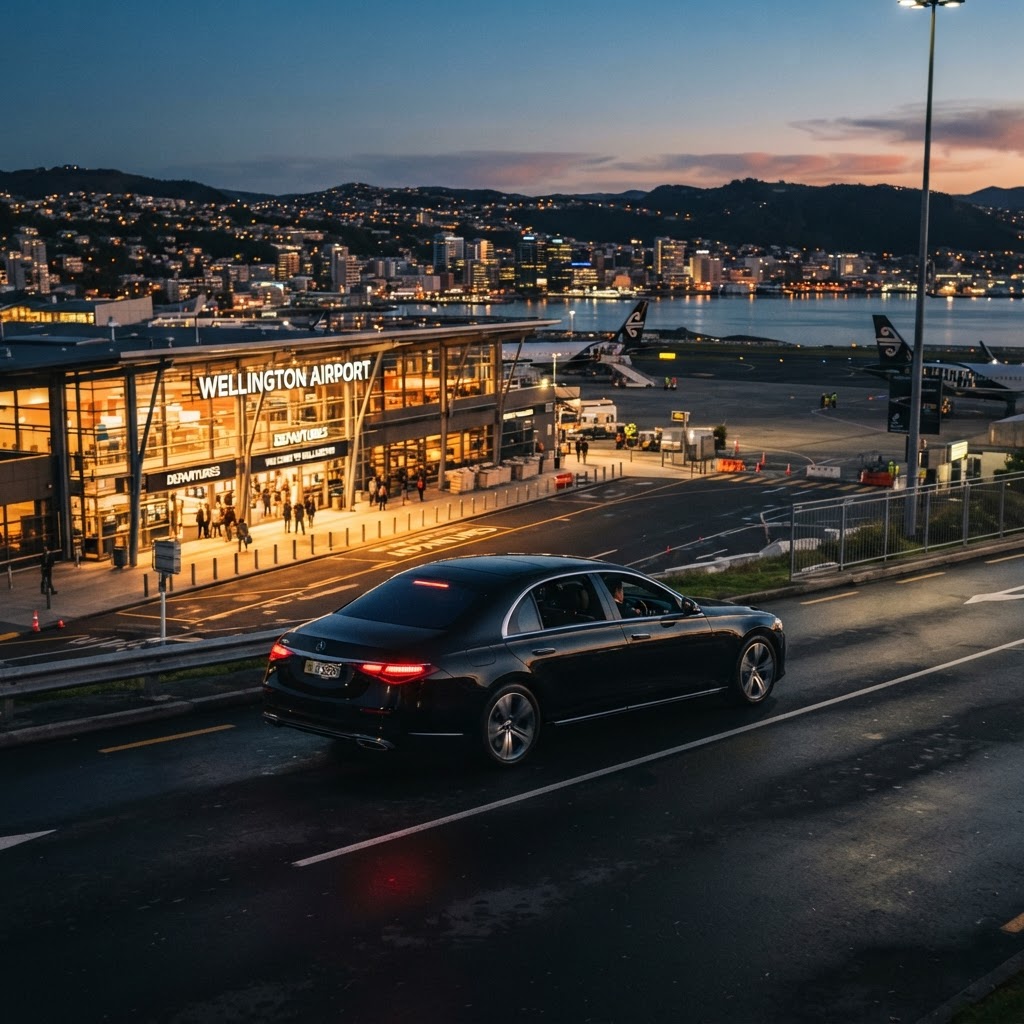
Best Way to Get from Wellington Airport to CBD Hotels with a Private Chauffeur
Wellington Airport sits just 6.5 kilometres southeast of the CBD—a deceptively short distance that presents unique logistical challenges for arriving travellers. The route, terrain, traffic patterns, and vehicle requirements make this one of New Zealand's most operationally demanding airport-to-hotel transfers, particularly for corporate and diplomatic arrivals where punctuality and presentation matter.
This guide covers what actually separates a private chauffeur transfer from app-based rideshare, the route considerations specific to Wellington's geography, vehicle selection for the run, and the operational markers that distinguish genuine chauffeur operators from sole traders operating under business names.
The Wellington Airport to CBD Route: Two Options, Different Trade-offs
There are effectively two routes from Wellington Airport (WLG) to central city hotels, and the choice depends on time of day, traffic conditions, and whether your hotel sits on the northern or southern edge of the CBD.
Route 1: Calabar Road via Kilbirnie and Mount Victoria Tunnel (5.8 km, 12–18 minutes)
The most direct route for hotels along The Terrace, Lambton Quay, and the Parliamentary precinct. Takes Calabar Road north through Kilbirnie, then via the Mount Victoria Tunnel into the city. This route is fastest during off-peak but becomes congested during morning (7:30–9:00 AM) and evening (4:30–6:00 PM) peaks when tunnel traffic stacks.
Route 2: Cobham Drive and Oriental Parade waterfront (7.2 km, 14–22 minutes)
The scenic coastal alternative via Cobham Drive, around Evans Bay, and north along Oriental Parade into the city. Slightly longer in distance but often faster during peak congestion when the tunnel route stalls. Preferred for arrivals heading to waterfront hotels (InterContinental, QT Wellington) and for clients who value a visual introduction to the harbour.
A qualified chauffeur operator will monitor real-time traffic, adjust routing dynamically, and communicate ETA updates if conditions shift. This is route intelligence, not navigation—a distinction lost on app-based drivers unfamiliar with Wellington's tidal traffic patterns.
What "Private Chauffeur" Actually Means (vs. Premium Rideshare)
The term "private chauffeur" is used loosely across the transport market. Operationally, it should denote five distinct service elements that separate it from rideshare:
1. Pre-assigned driver and vehicle
Your driver and specific vehicle are allocated before your flight lands. No dispatch lottery, no uncertainty about vehicle type or driver identity. You know who's meeting you and what you're travelling in.
2. Flight tracking and on-ground coordination
The operator tracks your inbound flight in real time, adjusts pickup timing for delays or early arrivals, and repositions the driver accordingly. This is standard in genuine chauffeur operations; it's absent in most rideshare models where the driver is dispatched only when you request.
3. Meet-and-greet inside terminal (domestic and international)
Your driver meets you airside or at the arrivals hall with name board, assists with luggage, and escorts you to the vehicle. This is the visible operational marker of a pre-coordinated transfer, not a kerbside pickup.
4. Executive or luxury-tier vehicle as standard
Chauffeur service implies vehicle presentation and capability beyond consumer sedans. Expect Mercedes-Benz E-Class or S-Class, BMW 5 or 7 Series, or equivalent. Not economy hatchbacks rebadged as "executive" in app listings.
5. Corporate billing, GST invoicing, and travel policy compliance
Genuine operators provide itemised tax invoices, integrate with corporate travel management platforms, and support centralised billing. This is procurement-grade service infrastructure, not consumer payment apps.
If your "private chauffeur" quote doesn't include these five elements as standard, you're booking a rideshare with marketing copy—not a chauffeur transfer.
Vehicle Selection for the Wellington Airport–CBD Run
The 6.5-kilometre transfer is short, but vehicle choice still matters—particularly for passengers connecting from long-haul international flights (via Auckland or direct from Australia) or carrying event materials, sports equipment, or diplomatic baggage.
Sedans (Mercedes-Benz E-Class, BMW 5 Series)
Suitable for 1–3 passengers with standard luggage (two large bags, two carry-ons). Ideal for solo corporate travellers or couples. Boot capacity: approximately 540 litres.
Luxury sedans (Mercedes-Benz S-Class, BMW 7 Series)
For VIP, diplomatic, or C-suite arrivals where rear-seat space, ride quality, and vehicle presentation are critical. Enhanced climate control, extended legroom, and quieter cabin—material differences on even a 15-minute transfer.
SUVs and vans (Mercedes-Benz V-Class, Toyota Granvia)
Required for groups of 4+ passengers, families with child seats, or travellers with oversized luggage (golf clubs, dive gear, production equipment). The V-Class offers seating for up to six with luggage space intact—critical for hotel groups or film crew arrivals.
What to avoid:
Late-model consumer vehicles (Toyota Camry, Hyundai Ioniq) marketed as "executive" in app platforms. These are cost-optimised rideshare vehicles, not chauffeur-grade fleet.
Wellington's hills, wind, and tight CBD hotel access points (particularly The Terrace and Thorndon properties) demand vehicles with power, stability, and professional-grade handling. Underpowered sedans and ageing fleet units show their limitations quickly.
Timing Considerations: When to Book, When to Arrive Kerbside
Wellington Airport operates 24/7, but practical transfer timing depends on your flight arrival window and hotel check-in requirements.
Domestic arrivals (Auckland, Christchurch, Queenstown):
Disembark to kerbside in 8–12 minutes for carry-on passengers, 15–20 minutes with checked bags. Meet-and-greet drivers should be positioned landside within five minutes of wheels-down for flights under one hour.
Trans-Tasman arrivals (Sydney, Melbourne, Brisbane):
Immigration and baggage claim extends ground time to 25–40 minutes. Chauffeur operators track customs queue lengths and adjust positioning. Kerbside wait times beyond 10 minutes indicate poor flight monitoring.
Peak-hour arrivals (weekday mornings and late afternoons):
Allow an additional 6–10 minutes for the Mount Victoria Tunnel route during weekday peaks (7:30–9:00 AM, 4:30–6:00 PM). Operators should proactively route via Oriental Parade if tunnel congestion exceeds eight minutes.
Late-night and early-morning arrivals:
Wellington's first domestic arrivals land around 6:00 AM; last departures leave near midnight. Genuine 24/7 chauffeur operators maintain driver availability across all commercial flight windows—not "on request" surcharge models common with sole-trader operators.
What Separates Real Operators from Dressed-Up Sole Traders
Wellington's private transport market includes several dozen entities advertising "chauffeur services" and "executive transport." Operationally, fewer than five have genuine multi-vehicle fleet depth, employed driver teams, and 24/7 dispatch capability.
The competitive landscape breaks into three tiers:
Tier 1: Genuine multi-vehicle operators with employed drivers
Maintain dedicated Wellington-based fleet (6+ vehicles), employed or long-term contracted chauffeurs, and real-time dispatch systems. Can handle simultaneous bookings, vehicle breakdowns, and last-minute requests without outsourcing. Legacy EPT operates at this tier, with Wellington-based fleet and drivers managed locally.
Tier 2: Owner-operators with 1–3 vehicles
Often high-quality service at small scale, but limited surge capacity and no backup vehicle or driver redundancy. Bookings during vehicle maintenance or driver illness get outsourced to other sole traders or cancelled. Fine for low-stakes personal travel; risk-inappropriate for corporate or diplomatic movement.
Tier 3: Virtual brands and booking aggregators
No owned fleet. These are referral businesses or white-labelled apps that dispatch to whichever driver accepts the job. Vehicle type, driver identity, and service quality are variable. The "chauffeur company" is a website and a payment gateway—nothing more.
When evaluating Wellington airport transfer providers, ask three qualifying questions:
- Do you own and operate your Wellington fleet, or do you subcontract?
- How many vehicles and drivers do you have based in Wellington?
- What happens if my assigned vehicle or driver is unavailable on the day?
The answers separate genuine operators from marketing facades quickly.
Making the Right Choice for Your Wellington Arrival
The best way to get from Wellington Airport to your CBD hotel with a private chauffeur is to pre-book with an operator who maintains owned Wellington fleet, tracks your flight in real time, assigns a specific vehicle and driver before you land, and meets you inside the terminal—not kerbside after you call.
That's not rideshare. That's not a sole trader with a business name. That's genuine chauffeur service, and in New Zealand's capital, only a handful of operators deliver it consistently.
For corporate, diplomatic, or VIP arrivals where timing, vehicle quality, and billing integration matter, the operator you choose determines whether your Wellington arrival is seamless—or a reminder that not all "executive transport" claims are operationally equal.
Ready to book your Wellington Airport transfer with New Zealand's only true nationwide private transport operator? Get a fixed-price quote or speak to the Legacy EPT team at our contact page.
Frequently Asked Questions
How far is Wellington Airport from the CBD and how long does a private transfer take?
Wellington Airport sits just 6.5 kilometres southeast of the CBD. The direct route via Calabar Road, Kilbirnie and the Mount Victoria Tunnel is 5.8 km and takes 12–18 minutes. The scenic alternative via Cobham Drive and Oriental Parade is 7.2 km and takes 14–22 minutes. A qualified chauffeur monitors real-time traffic and adjusts routing dynamically — particularly important during weekday peaks (7:30–9:00 AM and 4:30–6:00 PM) when tunnel traffic stacks.
What's the difference between a private chauffeur transfer and premium rideshare?
Genuine chauffeur service includes five elements as standard: a pre-assigned driver and vehicle (no dispatch lottery), real-time flight tracking with on-ground coordination, meet-and-greet inside the terminal with a name board, an executive or luxury-tier vehicle (Mercedes-Benz E-Class or S-Class, BMW 5 or 7 Series) as standard, and corporate billing with GST invoicing and travel-policy compliance. If your 'private chauffeur' quote doesn't include all five, you're booking rideshare with marketing copy.
Which vehicle should I book for a Wellington Airport to CBD transfer?
Sedans (Mercedes-Benz E-Class, BMW 5 Series) suit 1–3 passengers with standard luggage. Luxury sedans (S-Class, BMW 7 Series) are for VIP, diplomatic or C-suite arrivals where rear-seat space and ride quality matter. SUVs and vans (Mercedes-Benz V-Class, Toyota Granvia) are required for groups of 4+, families with child seats, or oversized luggage. Avoid late-model consumer vehicles (Toyota Camry, Hyundai Ioniq) marketed as 'executive' in app platforms — these are rideshare vehicles, not chauffeur-grade fleet.
How long after landing will my chauffeur be waiting at Wellington Airport?
For domestic arrivals, disembark to kerbside takes 8–12 minutes with carry-on, 15–20 minutes with checked bags — your meet-and-greet driver should be positioned landside within five minutes of wheels-down. Trans-Tasman arrivals add 25–40 minutes for immigration and baggage. A genuine chauffeur operator tracks customs queue lengths and adjusts positioning; kerbside wait times beyond 10 minutes indicate poor flight monitoring.
How do I tell a real Wellington chauffeur operator from a sole trader or booking aggregator?
Ask three questions: Do you own and operate your Wellington fleet, or do you subcontract? How many vehicles and drivers do you have based in Wellington? What happens if my assigned vehicle or driver is unavailable on the day? Tier 1 operators own 6+ Wellington vehicles, employ drivers, and have 24/7 dispatch. Tier 2 owner-operators have 1–3 vehicles and no redundancy. Tier 3 virtual brands own no fleet — they dispatch to whoever accepts the job.
Is 24/7 chauffeur service available at Wellington Airport?
Wellington's first domestic arrivals land around 6:00 AM and last departures leave near midnight. Genuine 24/7 chauffeur operators maintain driver availability across all commercial flight windows as standard — not 'on request' surcharge models common with sole-trader operators. If late-night or early-morning availability carries a premium surcharge, you're not dealing with a full-service operator.
Michael Graves
Competitive Analysis & Market Positioning · Based in Auckland
Michael leads competitive analysis and market positioning for Legacy EPT across New Zealand's private transport sector. He specialises in operational differentiation and service quality benchmarking in the executive transport category.