
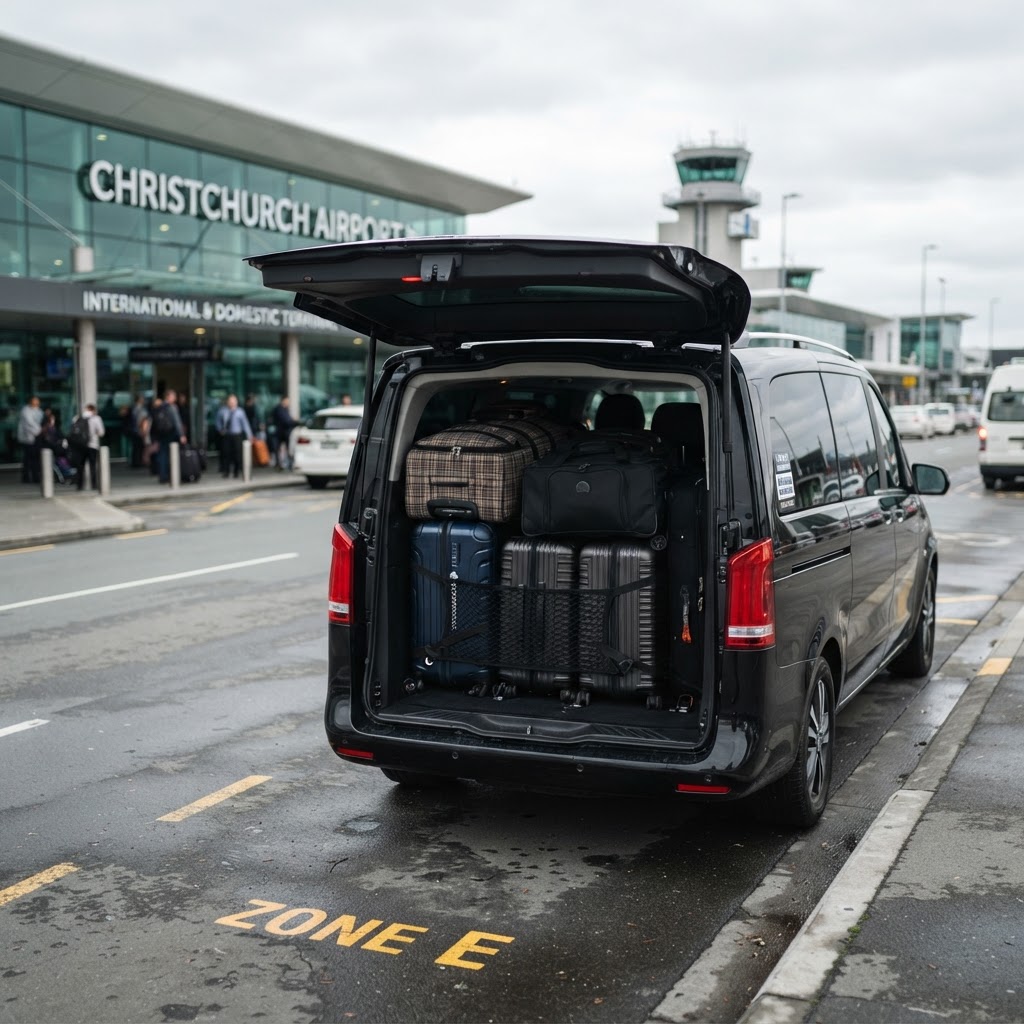
Luggage-Friendly Private Van Transfer: Christchurch Airport to Akaroa Cruise Port
The Christchurch Airport to Akaroa cruise port transfer presents specific operational requirements that most private transport operators underestimate. The 90-kilometre route crosses Banks Peninsula via Summit Road or the lower Christchurch-Akaroa Road (SH75), typically requiring 90 minutes door-to-dock under normal conditions. The critical variable isn't distance—it's luggage volume for cruise embarkation combined with passenger comfort over variable topography.
Cruise passengers arriving at Christchurch Airport (CHC) for same-day Akaroa embarkation carry materially different baggage loads than standard airport transfers. Two passengers typically travel with four checked bags plus carry-on luggage—a configuration that eliminates sedan and small SUV options immediately. The question isn't whether you need a van. The question is whether your chosen operator runs genuine commercial passenger vans with documented luggage specifications, or stretched passenger vehicles marketed as vans.
Vehicle Specification: What "Luggage-Friendly" Actually Means
A luggage-friendly private van for the Christchurch-Akaroa cruise route requires three non-negotiable capabilities:
Minimum 1,030 litres of cargo volume with all passenger seats occupied. This accommodates four large checked bags (75cm height each), two carry-ons, and incidental items without stacking above sightlines or compromising passenger legroom.
Rear access independent of passenger egress. Cruise embarkation operates under terminal-side time windows. Passengers must exit at the terminal entry while the driver proceeds to designated baggage drop zones. Vehicles requiring passenger seat manipulation to access luggage create operational delays that cascade into missed check-in slots.
Climate-controlled cargo area. Banks Peninsula summer temperatures routinely exceed 28°C. Luggage compartments sharing cabin climate control prevent heat damage to medications, electronics, and temperature-sensitive items during the 90-minute journey.
The Mercedes-Benz V-Class specification meets all three requirements with 1,030 litres behind the third row, independent rear door access, and unified climate zones. The Volkswagen Multivan offers comparable volume at 1,121 litres. Toyota Hiace commercial conversions frequently exceed both at 1,200+ litres, though ride quality deteriorates on the Summit Road switchbacks.
Standard sedans—even premium models like the BMW 5 Series or Mercedes-Benz E-Class—offer 530-540 litres maximum. That's adequate for two passengers with two bags each, but fails structurally for cruise embarkation loads.
Route Considerations: SH75 vs Summit Road
Two routes connect Christchurch Airport to Akaroa cruise port. The choice depends on weather, time constraints, and passenger preference for scenery versus efficiency.
State Highway 75 (Christchurch-Akaroa Road) runs 90 kilometres through Little River, following the harbour shoreline before climbing into Akaroa. Journey time: 85-95 minutes under normal conditions. This is the operational default for cruise embarkation transfers because it avoids Summit Road weather exposure and provides consistent travel times for tight ship departure schedules.
Summit Road via Gebbies Pass cuts distance to 82 kilometres but adds 15-20 minutes due to switchback geometry and 600-metre elevation gain. The route offers superior views across Lyttelton Harbour and the Canterbury Plains. However, Summit Road becomes operationally non-viable in fog, ice, or high winds—conditions that occur 40+ days annually between May and September. No professional operator recommends Summit Road for fixed-time cruise embarkation unless specifically requested and weather is confirmed.
For cruise passengers, the operational standard is SH75 outbound to Akaroa, with Summit Road offered for return transfers when schedule flexibility exists.
Akaroa Cruise Port Terminal Logistics
Akaroa operates as a tender port—cruise ships anchor in the harbour and transfer passengers via tender boat to the shoreside terminal at Daly's Wharf. This creates specific timing and baggage handling requirements.
Most cruise lines operate embarkation windows between 11:00-13:00 for afternoon departures. However, tender boarding begins 90 minutes prior to ship departure, and check-in typically closes 30 minutes before first tender. A 14:00 departure requires terminal arrival by 11:30 at the absolute latest.
Passengers on morning international flights into Christchurch (common from Australia on Qantas and Air New Zealand services landing 08:30-10:00) face tight connections. CHC international baggage claim averages 35-40 minutes. Customs adds another 10-15 minutes. Meeting your driver at 09:30 and departing by 09:45 delivers you to Akaroa at 11:15—workable but with no buffer for flight delays.
Professional operators monitor inbound flight status in real-time and adjust departure timing dynamically. This isn't a value-add service—it's baseline operational competence for cruise embarkation transfers.
Baggage handling at Daly's Wharf operates porter-free. Your driver delivers luggage to the terminal entry, but you manage bags from that point to tender boarding. Wheeled luggage is essential. Bags stacked in passenger footwells or requiring overhead lifting from cargo stacks create embarkation delays.
Passenger Capacity and Group Configurations
Van specifications list maximum passenger capacity—typically 6-8 seats depending on model. Actual usable capacity for cruise transfers with full luggage is materially lower.
A Mercedes-Benz V-Class configured for 7 passengers provides the specified 1,030 litres of cargo only when the third row is occupied. With six passengers using rows one and two, cargo volume increases to approximately 1,400 litres—adequate for three passengers with typical cruise baggage. Attempting to seat four passengers with four checked bags each requires the third row, which reduces cargo to insufficient volume.
The practical configuration for cruise embarkation transfers:
- 2 passengers, 4-5 checked bags: Any 6-seat premium van, all rows available
- 3 passengers, 6 checked bags: 7-8 seat van, third row in use, bags in rear cargo only
- 4 passengers, 8 checked bags: Two vehicles or commercial Hiace with custom cargo configuration
- 5+ passengers: Multiple vehicles non-negotiable
Operators who accept bookings for four passengers with standard cruise luggage in a single V-Class are either running third-party contractors with unknown vehicle specs or planning to stack bags in passenger areas—both unacceptable for a premium service.
Booking Operational Standards for Airport-to-Cruise Transfers
The Christchurch Airport to Akaroa cruise transfer sits at the intersection of flight timing uncertainty and fixed cruise departure schedules. This demands specific booking protocols.
Flight monitoring is mandatory, not optional. Your transport operator should request flight numbers at booking and track status from 24 hours pre-departure. Delays of 30-60 minutes are common on trans-Tasman morning arrivals due to Australian airport congestion. Operators without real-time flight tracking systems cannot adjust pickup timing dynamically.
Vehicle specification confirmation in writing. Request specific make, model, and cargo volume in litres. "Premium van" or "luxury people-mover" are marketing terms without operational meaning. Mercedes-Benz V-Class, Volkswagen Multivan, or Toyota Hiace with specified luggage capacity are confirmable specifications.
Driver cruise terminal familiarity. Akaroa is a small port with single-terminal operations, but tender schedules vary by ship and cruise line. Your driver should ask which cruise line you're sailing with and confirm the embarkation window—not just drop you at Daly's Wharf and depart.
Contingency routing for weather or road events. SH75 experiences periodic closures for serious crashes or weather events. Summit Road provides the alternate route, but only if passable. Professional operators maintain real-time NZTA traffic monitoring and communicate alternate routing before departure, not during the journey.
Why Vehicle Age and Maintenance Matter for Peninsula Routes
Banks Peninsula roads—particularly Summit Road—expose vehicle maintenance deficiencies that remain hidden on urban motorway routes. Brake fade on descent gradients, suspension wear on switchback camber, and cooling system capacity on extended climbs are invisible in Auckland airport flat-route operations but critical on the Christchurch-Akaroa run.
Brake system specifications designed for loaded passenger vans exceed sedan requirements. A fully loaded V-Class at 3,200kg descending Summit Road generates materially higher brake temperatures than the same vehicle on SH1 motorway cruising. Operators running high-mileage vehicles (180,000+ km) without documented brake system replacement are creating safety exposure.
Suspension and tyre specifications determine ride quality on variable road surfaces. SH75 includes 15+ kilometres of chip-seal surface between Little River and Barrys Bay—acceptable on new suspension, punishing on worn components. Passenger comfort deteriorates rapidly when shock absorbers exceed 100,000km service life.
Request vehicle age and maintenance records if you're booking an operator you haven't used previously. Fleet age under 4 years with documented service intervals is the professional standard. Operators unwilling to provide this information are typically running aged contractor vehicles under brand aggregation.
Planning a Christchurch Airport to Akaroa cruise port transfer with full luggage? Legacy EPT operates specified Mercedes-Benz V-Class and Volkswagen Multivan vehicles nationwide with documented cargo capacity, real-time flight monitoring, and driver cruise terminal protocols across all New Zealand ports. Request a quote with your flight details and cruise line, or contact our dispatch team for vehicle specification confirmation and route timing for your specific embarkation window.
Rob Snelling
Fleet Specification & Operational Technology · Based in Auckland
Rob leads fleet specification and operational technology for Legacy EPT's nationwide network. He specialises in vehicle capability matching, terminal logistics, and route-specific service design across New Zealand's cruise and airport transfer sectors.