National Freshwater Conference 2027: Ground Transport for Multi-Day Government Delegations
Planning Transport for Annual Government Conferences
When a national government conference returns to the same city year after year, the operational risk lies not in novelty but in complacency. The seventeenth iteration of a large-scale policy gathering - particularly one drawing ministerial delegations, regional council representatives, iwi partners, central agency officials, and international guests - demands the same level of operational discipline as the first.
Legacy operates multi-day ground transport for government and MICE events across New Zealand's regional centres, including Auckland. The capability required extends well beyond moving groups between an airport and a single venue. It involves coordinating staggered arrivals across domestic and international flights, managing itinerary changes driven by Select Committee schedules or Cabinet sittings, accommodating secure transport requirements for ministerial or diplomatic attendees, and providing account-managed invoicing that reconciles with government procurement frameworks.
What Government Event Planners Require
The procurement specification for a conference like this - annual, multi-stream, cross-agency - will typically call for a primary operator rather than a patchwork of subcontracted providers. That operator must demonstrate fleet ownership (not marketplace aggregation), employed professional drivers (not gig contractors), and a dispatch system capable of real-time flight monitoring and live itinerary adjustment.
Auckland presents specific logistical considerations. The city's two international and domestic terminals sit 20 minutes apart by road when arrivals overlap. Delegates travelling from Wellington, Christchurch, Napier, or Palmerston North may arrive within the same thirty-minute window across multiple domestic gates. International guests - particularly from Pacific Island nations or Australian state agencies - require meet-and-greet coordination inside the international arrivals hall, not curbside collection.
A capable operator will position vehicles according to actual flight touchdown and gate assignment, not the schedule printed six weeks earlier. The dispatch platform monitors each inbound service in real time and adjusts driver positioning accordingly. When a Wellington flight holds for weather or a Christchurch connection is re-timed, the driver receives updated instructions without the event organiser needing to make a phone call.
Multi-Day Coordination and Itinerary Flexibility
Government conferences rarely follow a fixed timetable. A keynote may overrun. A ministerial media stand-up may be called at short notice. A breakout session scheduled for two hours may collapse into forty minutes, releasing delegates early. Field visits - to a wastewater treatment facility, a wetland restoration site, a catchment monitoring station - are contingent on weather, tide, or site access permissions that shift.
The ground transport provider must operate as an extension of the event's operational team, not as a rigid pre-booked service. This requires live communication between the event manager, the dispatch system, and the driver network. It also requires vehicles and drivers held in reserve or re-tasked mid-day without punitive rebooking fees - a flexibility incompatible with marketplace or per-booking pricing models.
Legacy's model is built for this: account-managed relationships, employed drivers who understand the cadence of multi-day events, and a dispatch platform that treats itinerary changes as routine operational inputs rather than exceptions.
Fleet Mix for Delegations of Variable Size
A national conference will generate transport requests across a wide spectrum: solo ministerial movements requiring discreet executive sedans, small regional council delegations of four to six travelling together, larger international groups of twelve to fifteen requiring people-movers or minibuses, and occasional full-coach movements for site visits or social functions.
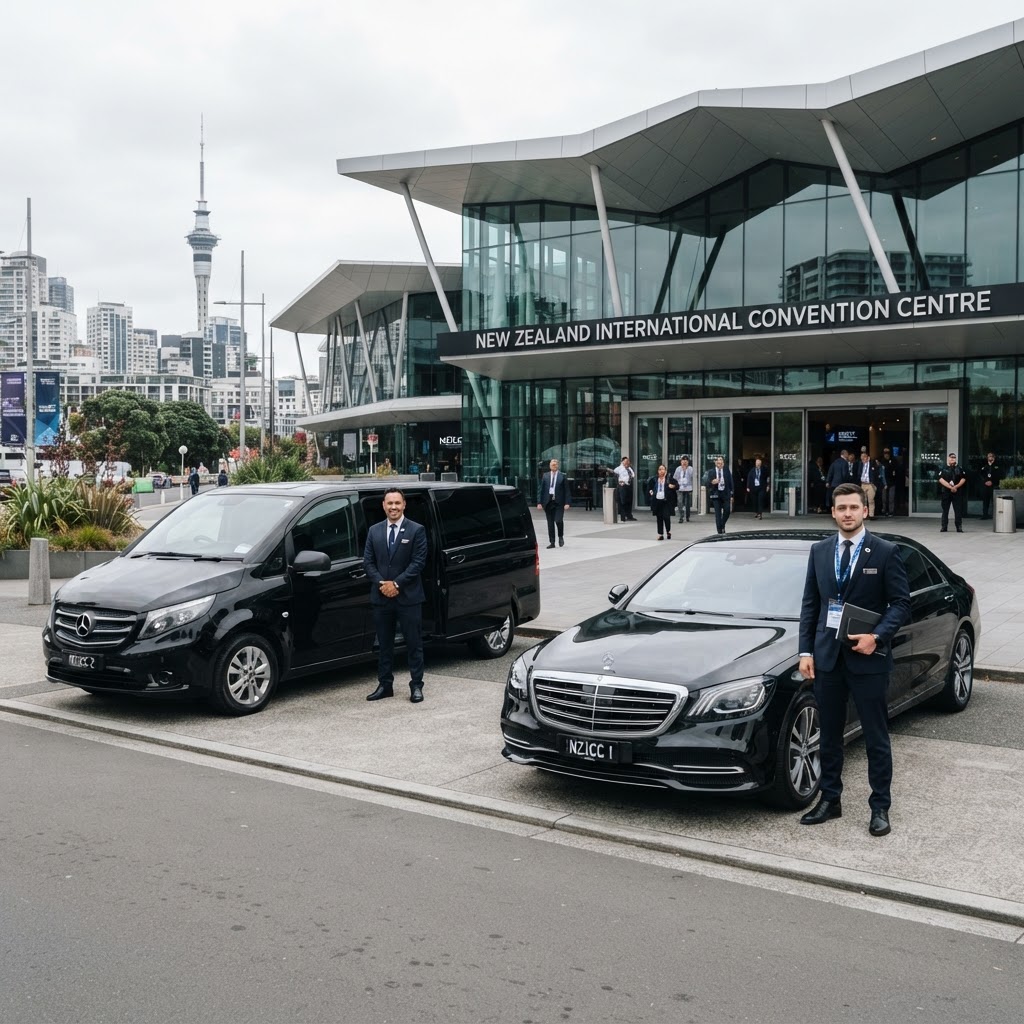
The operator must field a mixed fleet without resorting to subcontracting or substituting vehicle types at short notice. Legacy operates a wholly owned European fleet - Mercedes-Benz, BMW, Volkswagen - across its regional network. This ensures consistent presentation, maintained interiors, and driver familiarity with each vehicle's configuration and accessibility features.
For government work, this consistency matters. A delegation accustomed to a specific vehicle configuration on day one should not face a different supplier, a different vehicle standard, or a different driver briefing level on day two.
Procurement, Invoicing, and Reporting
Government agencies and their event delivery partners operate within defined procurement frameworks. They require tax invoices that separate GST, account codes that align with Vote structures, and consolidated billing that rolls up multi-day, multi-passenger movements into a single reconcilable statement.
Legacy's billing and reporting architecture is designed for corporate and government account relationships. Each booking is logged with passenger name, cost centre, pickup and drop-off timestamp, and vehicle type. At month-end or event-end, the account manager provides a consolidated statement and, where required, a movement log for audit or reconciliation purposes.
This is not a consumer rideshare receipt model. It is an invoicing and reporting capability built for professional buyers who must account for expenditure within formal finance and procurement systems.
Why Single-Source Operators Reduce Risk
Event organisers face a choice: engage a primary operator with the fleet depth and dispatch capability to manage the full ground transport scope, or distribute the work across multiple providers and manage the coordination risk internally.
For a multi-day government conference, the latter approach introduces fragmentation. When a delegate misses a transfer, it is unclear which provider was responsible. When an itinerary changes, multiple suppliers must be notified separately. When a vehicle breaks down or a driver calls in unwell, the organiser must find and brief a replacement.
A single-source operator internalises that coordination risk. Legacy's operations platform manages the full delegate manifest, monitors all inbound flights, dispatches all movements, and provides a single point of contact for the organiser. If a vehicle substitution is required, it happens within the same fleet, with the same service standard, and without the organiser needing to re-brief a new supplier.
This is the operational moat that matters when government reputation and delegate experience are both on the line.
Planning transport for a multi-day government conference in Auckland? Legacy operates owned fleet, employed drivers, and account-managed coordination built for ministerial, diplomatic, and cross-agency movements. Request a quote with your delegate profile, or contact our corporate team to scope a single-source transport plan aligned to your conference timeline.
Frequently Asked Questions
How far is Auckland Airport from central Auckland conference venues like the NZICC or Aotea Centre?
Auckland Airport sits approximately 21 kilometres south of the city centre. Transfer time to venues such as the New Zealand International Convention Centre or Aotea Centre is typically 25 to 35 minutes, depending on time of day and traffic conditions. Legacy's dispatch system monitors flight arrivals in real time and adjusts driver positioning to meet actual, not scheduled, arrival times.
Can Legacy accommodate ministerial or diplomatic transport requirements for government conferences?
Yes. Legacy operates executive vehicles and employs professional drivers experienced in secure, discreet transport for ministerial, consular, and senior official movements. The booking process accommodates specific briefing, vehicle configuration, and privacy requirements, and the operations platform maintains confidentiality of passenger identity and itinerary details.
What vehicle types does Legacy operate for mid-sized regional delegations of six to twelve people?
Legacy's owned fleet includes European people-movers and minibuses suited to groups of this size, with space for luggage and professional presentation suitable for government and corporate delegations. Vehicle assignment is managed centrally within the same operational platform, so itinerary changes or passenger additions are coordinated without switching suppliers or vehicle standards.
Does Legacy provide consolidated invoicing for multi-day government conferences?
Yes. Legacy's account-managed billing provides consolidated tax invoices that itemise movements by passenger, date, cost centre, and vehicle type. This supports government procurement reconciliation and audit requirements, and avoids the per-transaction receipt model typical of consumer rideshare platforms.
Can Legacy manage same-day itinerary changes for conference delegates during a multi-day event?
Yes. The operations platform allows live itinerary updates coordinated between the event manager, dispatch, and driver network. When session times shift, site visits are re-scheduled, or delegates require earlier or later pickups, changes are actioned within the same system without requiring new bookings or supplier coordination.
Richard Gee
Legacy EPT Operations
Richard brings over a decade of experience in premium ground transport operations across New Zealand, specialising in VIP, conference and executive transport coordination.