
On-Site Transport Coordination for Auckland Events: What Works at Scale
When a multi-day conference in Auckland involves 300 delegates, four venue changes, VIP airport pickups across 18 international flights, and a gala dinner requiring staggered departure slots, the difference between functional transport and operational chaos is on-site coordination.
Most transport operators dispatch remotely. A coordinator sits in an office somewhere, receives requests by phone or app, and assigns vehicles based on availability. That model works adequately for predictable airport runs or fixed-time corporate shuttles. It fails quickly under the variable demand, last-minute changes, and VIP-sensitivity typical of MICE events, incentive programmes, product launches, and corporate conferences in Auckland.
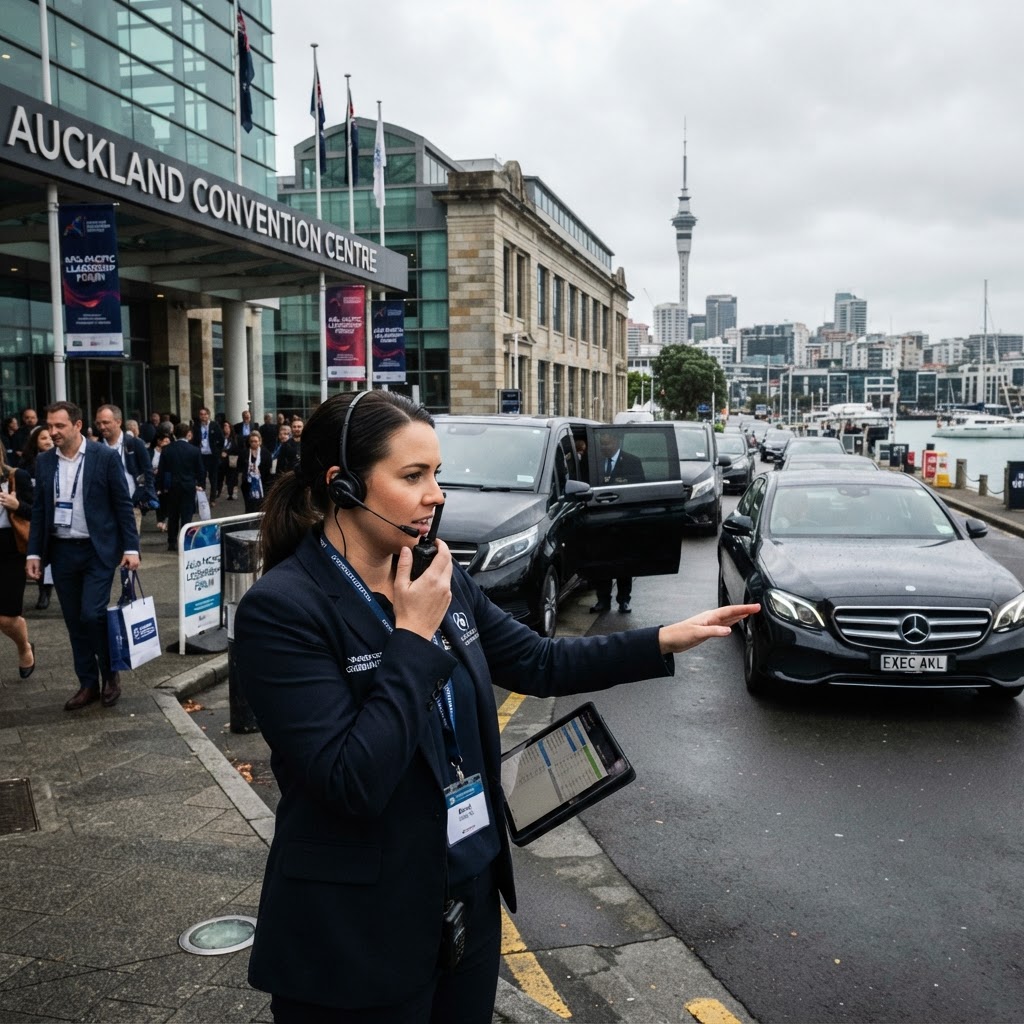
On-site coordination means a dedicated transport coordinator embedded at the event venue, equipped with direct radio contact to drivers, real-time visibility of vehicle location and status, and authority to redeploy assets without remote approval loops. It transforms transport from a vendor service into an integrated operational function of the event itself.
This article examines what functional on-site coordination requires, why it's rare in the New Zealand market, and what procurement teams and event managers should demand when transport is a critical path item.
Why Remote Dispatch Fails Under Event Conditions
Remote dispatch works when demand is predictable and timing is fixed. It struggles when:
- VIP arrival times shift due to flight delays, and a CEO now needs immediate pickup while three other executives are still 90 minutes out
- A breakout session runs 20 minutes late, and 40 delegates scheduled for 3:00pm departures now need vehicles at 3:25pm
- A sponsor requests an unscheduled airport run for a guest speaker who wasn't on the original manifest
- Weather delays affect ferry schedules, requiring real-time rerouting of delegates booked for Waiheke Island site visits
- A medical event requires immediate vehicle redeployment, and the nearest available car is 12 minutes away but unknown to an office-based dispatcher
Each scenario requires immediate situational awareness and decision authority. A remote dispatcher relies on second-hand information relayed by phone, lacks visibility into venue conditions (traffic around the venue entrance, security delays, pedestrian flow), and cannot visually confirm vehicle readiness or driver briefing.
An on-site coordinator sees the delay happen, radios the driver directly, redeploys the closest vehicle, and updates the client in real time. The decision cycle compresses from minutes to seconds.
What Functional On-Site Coordination Requires
Embedding a coordinator at an event venue is operationally expensive and structurally complex. It requires:
Fleet Scale and Driver Depth
On-site coordination is only viable when the operator has sufficient vehicles and drivers allocated to the event to make real-time redeployment meaningful. If only three vehicles are assigned to a 200-person conference, there's nothing to redeploy. The coordinator becomes a messenger, not a decision-maker.
Functional coordination assumes a fleet allocation proportional to peak demand, plus reserve capacity for unscheduled requests. For a typical three-day Auckland conference with 250-400 delegates, that means 8-15 vehicles on dedicated assignment, with an additional 3-5 on standby during high-demand windows (opening day arrivals, gala dinner, closing day departures).
Operators without scale cannot afford that allocation. A 1-3 vehicle operation cannot station a coordinator on-site because there are no assets to coordinate.
Direct Driver Communication Systems
On-site coordinators require radio or integrated dispatch systems that allow instant, broadcast communication with all drivers assigned to the event. Mobile phones introduce delay, require individual calls, and lack the group coordination capability of radio dispatch.
Legacy EPT deploys dedicated event radios for coordinators and drivers on large-scale MICE assignments, integrated with the fleet management system for real-time vehicle location visibility. Coordinators can broadcast updates to all drivers simultaneously ("Breakout session 3 is running 15 minutes late, hold all 3:00pm pickups until further notice") and redirect individual vehicles without multi-call loops.
Most small operators rely on mobile phones and group SMS. The coordination lag is measurable and compounds under pressure.
Decision Authority and Client Interface
An effective on-site coordinator must have authority to redeploy vehicles, adjust schedules, and commit additional resources without escalating every decision to a manager. That requires operational trust, which only comes from experience and training.
The coordinator also functions as the client-facing transport liaison, fielding requests from event managers, VIP handlers, and delegates directly. This requires fluency in event terminology, understanding of MICE operational cadence, and ability to translate client requests into dispatch instructions without ambiguity.
Operators who position junior staff or drivers in "coordination" roles often lack this capability. The person holding the clipboard may have radio contact, but not decision authority or client credibility.
Contingency Planning and Venue Familiarity
On-site coordinators arrive with pre-event briefings covering venue load zones, security protocols, VIP routing, parking restrictions, and contingency plans for high-probability failure modes (traffic delays on Grafton Bridge, road closures around Wynyard Quarter, weather impacts on Waiheke ferry schedules).
For Auckland specifically, coordinators must understand:
- SkyCity Convention Centre and Auckland Town Hall load zone protocols, including security screening for certain event types
- Viaduct and Wynyard Quarter traffic patterns during America's Cup events, cruise ship arrivals, or concurrent conferences
- Airport pickup choreography for international VIP arrivals, including customs fast-track coordination and airside access where applicable
- Timing variables for North Shore, West Auckland, or Waiheke Island movements, especially during peak commuter windows
This knowledge isn't generic. It's venue-specific, city-specific, and built from repeated operational exposure.
The New Zealand Market Reality
New Zealand's private transport market is characterised by operational fragmentation. The vast majority of operators are 1-3 person businesses operating under brand names that suggest scale ("Executive," "Chauffeur," "Premier") but lack the fleet depth, driver network, or dispatch infrastructure to support embedded coordination.
These operators handle predictable airport transfers and corporate shuttles competently. They cannot support multi-day MICE events or incentive programmes where on-site coordination is a functional requirement, not a luxury.
When event managers or DMCs contract with undersized operators for large events, one of three things happens:
- The operator subcontracts vehicles from other small operators, losing direct control and communication
- The operator provides a "coordinator" who is actually just a phone relay, passing requests back to a remote dispatcher
- The operator overpromises and under-delivers, and the client discovers the capability gap mid-event when it's too late to change vendors
Procurement teams experienced in MICE transport often specify on-site coordination as a mandatory capability in RFPs, with requirements for minimum fleet allocation, direct driver communication systems, and named coordinator credentials.
What Legacy EPT Deploys for Auckland MICE Events
Legacy EPT operates on-site coordination as standard practice for events above 150 delegates or any event with VIP transport requirements. The deployment model includes:
- Named event coordinator embedded at the venue for the duration of the event, equipped with radio dispatch, tablet-based fleet visibility, and direct client contact authority
- Dedicated fleet allocation from Legacy EPT's Auckland-based fleet of Mercedes-Benz E-Class, V-Class, and Sprinter vehicles, scaled to peak demand plus 20% reserve capacity
- Driver briefing sessions pre-event, covering venue protocols, VIP handling, schedule overview, and contingency procedures
- Integration with event run sheets, including coordination with event managers, AV teams, catering, and security where transport timing affects other operational elements
For events requiring VIP or executive transport, coordinators manage discreet routing, advance vehicle positioning, and pre-arrival briefings to drivers on passenger preferences, accessibility requirements, or security protocols.
For incentive programmes and DMC partnerships, coordinators interface directly with tour directors and step-on guides, ensuring vehicle movements align with activity schedules, meal timings, and experience sequencing.
On-site coordination is included in Legacy EPT's corporate event services for qualifying events, not billed as an additional line item.
When On-Site Coordination Becomes Critical
On-site coordination shifts from optional to operationally critical when:
- VIP or executive participants are present, and transport delays affect high-value stakeholder experience
- Event schedules are variable or session-based, requiring real-time adjustment rather than fixed-time shuttles
- Multiple venues or off-site activities introduce routing complexity and timing dependencies
- International delegates require airport coordination across multiple inbound flights with variable arrival times
- Brand reputation or client perception is directly affected by transport experience (product launches, investor events, incentive programmes)
Event managers and procurement teams should specify on-site coordination as a mandatory deliverable in these contexts, with verification of operator capability during the RFP or tendering process.
If your Auckland event depends on transport working seamlessly under variable demand, request a briefing on Legacy EPT's on-site coordination model. Contact our corporate events team or request a detailed event transport quote with coordination deployment specifics included.
Richard Gee
Corporate & MICE Sector Strategy · Based in Wellington
Richard Gee leads corporate and MICE sector strategy for Legacy EPT across government, diplomatic, film production, and large-scale conference transport. He specialises in procurement structures and operational delivery for multi-day, multi-venue events.
Plan embedded event transport coordination
MICE Transport · Auckland Services · Contact Corporate Events