
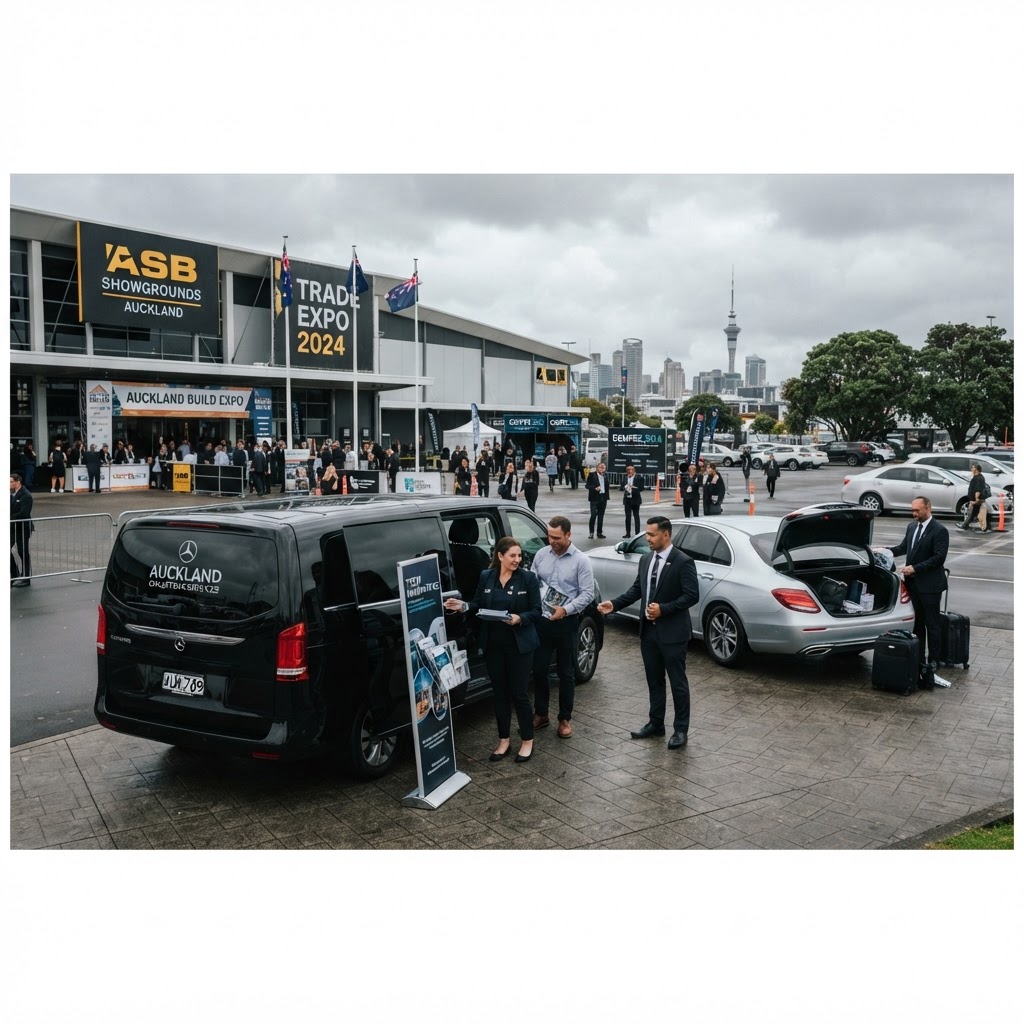
Ground Transport for Large-Scale Expo Operations in Auckland
What Trade Expo Transport Actually Requires
Ahead of the Covi RV & Outdoor SuperShow in Auckland, organisers and exhibitors face a familiar challenge: coordinating arrivals, moving VIP groups between venues and accommodation, and maintaining schedule integrity across multiple days when hundreds of exhibitors and thousands of attendees converge on a single venue precinct.
Large-format trade and consumer expos present distinct ground transport requirements that differ markedly from corporate conferences or point-to-point airport transfers. Exhibitor teams often travel with bulky display materials that won't fit in standard sedans. International buyers and media arrive on staggered flight schedules throughout the event window. VIP manufacturer delegations expect continuity - the same driver, the same vehicle standard - across multiple days. And unlike static conferences, expo operations generate dynamic, day-of requests as stand schedules shift and sponsor obligations emerge.
These are not problems solved by marketplace apps or ad-hoc taxi hire. They require an operator with the infrastructure to manage complexity at scale: an owned fleet that can be staged and allocated without dependency on third-party availability, employed drivers who understand the rhythm of multi-day event operations, and a coordination platform that tracks live arrivals and adapts dispatch in real time.
Why Owned Fleet and Employed Drivers Matter for Expo Logistics
When an exhibitor lands at Auckland Airport two hours late due to an international connection delay, or when a sponsor requests an unscheduled transfer to a second venue across the city, the operator's structural capabilities become the difference between seamless execution and reputational damage.
Legacy operates an owned European fleet across New Zealand, with professional employed drivers who work within a single operational framework. This is not a brokerage model. Vehicles are allocated, maintained, and dispatched from within one system. When an expo organiser books transport for a three-day event window, the same operational team that monitors the first arrival on day one is managing dispatch and adjustments through to final departures on day three.
For events of this scale, that continuity is foundational. Exhibitor groups often require multiple vehicle types - executive sedans for senior management, larger people-movers for booth staff travelling together, and vehicles with luggage capacity for sample cases and display equipment. An owned fleet allows pre-staging and flexible reallocation as demand patterns emerge. An employed driver base means consistent service standards, familiarity with Auckland venue precincts and hotel zones, and the ability to handle multi-leg itineraries without handoffs between different operator networks.
Real-Time Flight Monitoring and Multi-Day Coordination
Trade expos draw participants from across the country and internationally. Auckland Airport receives exhibitor and buyer arrivals from Australian direct flights, Asian connections, and domestic services from Christchurch, Wellington, and Queenstown. Flight delays, gate changes, and early arrivals are routine, not exceptional.
Legacy's proprietary operations platform integrates real-time flight monitoring, allowing dispatch to track actual arrival times and position drivers accordingly. When an exhibitor's Sydney flight is delayed 90 minutes, the driver receives updated positioning instructions automatically. When a domestic connection lands early, the vehicle is already en route. This is not reactive coordination - it is structural capability built into the dispatch layer.
For multi-day events, the platform provides account-managed oversight. Event organisers and corporate travel managers access consolidated billing, live trip status, and adjustment workflows through a single coordination point. When an exhibitor adds a supplier dinner transfer on day two, or when a VIP media delegation requires a morning departure change, those requests flow through the same operational interface managing the broader event transport schedule.
Staging, Venue Knowledge, and Environmental Considerations
Large expos generate concentrated demand around venue precincts, particularly during peak arrival and departure windows. Auckland venues hosting events of this scale - whether at convention centres, exhibition halls, or mixed-use precincts - require drivers familiar with loading zones, traffic flow during event hours, and alternative routing when public access roads reach capacity.
Employed drivers working within Legacy's operational structure gain that venue knowledge through repeated deployment, not one-off jobs. They understand which hotel clusters house exhibitor groups, which venue access points remain open outside standard hours, and how to position for efficient pickup when hundreds of attendees are departing simultaneously.
For event organisers focused on sustainability and environmental impact - a growing consideration across New Zealand's business events sector - working with a single operator managing an efficient, well-maintained fleet reduces the carbon footprint compared to fragmented marketplace arrangements. Fewer vehicles, better routing intelligence, and coordinated dispatch translate directly into lower per-delegate emissions. For expos attracting outdoor and recreation sector participants, that alignment between operational efficiency and environmental responsibility is increasingly material.
The Coordination Layer That Scales
What distinguishes professional event transport from ad-hoc hire is not the presence of vehicles - it is the operational infrastructure that coordinates them. When 40 exhibitors require airport transfers across a six-hour window, when sponsor obligations generate unscheduled requests mid-event, and when VIP delegations expect the same service standard their international operations receive, the operator's platform architecture becomes the primary variable.
Legacy's end-to-end operations platform - dispatch, driver coordination, GPS tracking, account billing - runs across multiple New Zealand cities. This is a genuinely multi-region operator, not a single-city service extending coverage through partnerships. That structural footprint matters for national expos drawing exhibitors and buyers from across the country, and for international groups combining Auckland events with wider New Zealand itineraries.
For MICE planners, DMCs, and corporate travel managers evaluating ground transport for large-format expos, the question is not whether vehicles are available. The question is whether the operator can manage coordination complexity, maintain service continuity across multiple days, and adapt in real time as event dynamics shift. Those capabilities are not features - they are infrastructure. And infrastructure is what separates professional transport operations from marketplace aggregation.
Frequently Asked Questions
How does Legacy handle staggered exhibitor arrivals across multiple days for Auckland expos?
Legacy's operations platform monitors live flight arrivals and coordinates dispatch in real time, positioning drivers for actual landing times rather than scheduled estimates. Multi-day event bookings are managed through a single account interface, allowing adjustments and additions as exhibitor schedules evolve throughout the event window.
What vehicle types work best for exhibitor groups travelling with display materials and equipment?
Legacy operates an owned European fleet with multiple vehicle configurations, including executive sedans for senior management, larger people-movers for booth staff, and vehicles with extended luggage capacity for sample cases and display equipment. Vehicle allocation is coordinated within one operational system, allowing flexible staging based on group size and cargo requirements.
Can Legacy provide the same driver for VIP delegations across a three-day expo in Auckland?
Yes. Legacy employs professional drivers within a single operational framework, allowing continuity assignments when requested. VIP delegations often prefer the same driver and vehicle across multi-day events, and Legacy's employed driver base supports that coordination without dependency on third-party availability.
Does Legacy track international flight arrivals for exhibitors flying into Auckland from Australia or Asia?
Legacy's proprietary platform integrates real-time flight monitoring for international and domestic arrivals. When exhibitors' flights are delayed, land early, or experience gate changes, dispatch receives live updates and adjusts driver positioning accordingly. This capability is standard across all Auckland Airport transfers, not a premium add-on.
How does Legacy coordinate ground transport for both exhibitors and sponsor VIP groups during the same event?
All event transport is managed through Legacy's end-to-end operations platform, with account-managed oversight for organisers and corporate travel managers. Exhibitor transfers, sponsor obligations, and VIP movements flow through the same dispatch coordination layer, ensuring schedule integrity and allowing real-time adjustments as event requirements shift.
Hayden Panetta
Events & Sustainability · Legacy EPT
Hayden Panetta leads Legacy's events, sport, and sustainability work, focusing on the logistics of moving groups at scale and the operational decisions behind credible environmental practice in the ground-transport sector.